If you are searching for a dependable ceramic fiber supplier from India, you are already looking in the right place. India has become one of the most competitive sources of high-temperature insulation materials, offering consistent quality, flexible order sizes and attractive pricing for buyers in the Middle East, Europe, Africa, Southeast Asia and the Americas.
But not every supplier is the same. Differences in raw material purity, density, shot content and packing can decide whether your furnace lining lasts two years or six. In this guide, we explain what ceramic fiber is, which products and grades exist, how to compare suppliers, and what to check before you place an export order.
What Is Ceramic Fiber?
Ceramic fiber, also written as ceramic fibre or refractory ceramic fiber (RCF), is a lightweight insulation material made from alumina and silica. The raw materials are melted at very high temperature and spun or blown into fine fibers, which are then converted into blankets, boards, paper, modules, ropes and bulk wool.
It is widely used because it combines several properties that are hard to find together:
- Very low thermal conductivity, which reduces fuel consumption
- Low heat storage, so furnaces heat up and cool down faster
- Excellent thermal shock resistance
- Light weight compared with traditional refractory bricks
- Good chemical stability and flexibility for easy installation
You can read more about how refractory materials work in this overview of refractory materials on Wikipedia.
Why Buyers Choose a Ceramic Fiber Supplier from India
India’s industrial base is large and growing: steel, cement, petrochemicals, power, glass, ceramics and heat treatment all depend on high-temperature insulation. This domestic demand has created a mature manufacturing ecosystem. Buyers abroad benefit from it in several ways.
1. Competitive Pricing Without Cutting Quality
Lower labour and operating costs, together with locally available raw materials, allow Indian manufacturers to price competitively. Importers often save a meaningful percentage compared with European or American suppliers while still receiving products tested to international standards.
2. Wide Product Range from One Source
A good Indian exporter can supply blankets, boards, paper, modules, rope, tape and vacuum-formed shapes together. Buying everything from one supplier simplifies freight, documentation and quality control.
3. Flexible Order Quantities and Customisation
Many Indian suppliers accept trial orders and mixed-container loads. Custom sizes, densities and packing can be arranged, which is useful for distributors who serve several customer segments.
4. Strong Export Infrastructure
Major ports such as Mundra, Kandla, Nhava Sheva (JNPT) and Chennai handle containerised industrial cargo to every region. Gujarat in particular is a well-known industrial and export hub, giving faster dispatch and efficient logistics.
Types of Ceramic Fiber Products Supplied from India
The right product depends on the application, temperature and installation method. Here are the main forms you should know.
Ceramic Fiber Blanket
The most popular product. Blankets are needle-punched rolls used for furnace walls, roofs, kiln linings, boiler insulation and pipe wrapping. Common densities are 64, 96 and 128 kg/m³, with thicknesses from 6 mm to 50 mm.
Ceramic Fiber Board
Rigid boards offer higher compressive strength and are used as hot-face lining, back-up insulation, and in burner blocks and kiln car decks.
Ceramic Fiber Paper
Thin, flexible and smooth, paper is used for gaskets, expansion joints, seals and thermal barriers where precision matters.
Ceramic Fiber Modules
Pre-compressed folded blanket modules with anchoring systems allow fast furnace lining installation and are ideal for large industrial furnaces.
Ceramic Fiber Rope, Tape and Textiles
Used for door seals, flange sealing, expansion gaps and fire protection.
To see the full range available for export, visit our ceramic fiber products page.
Understanding Ceramic Fiber Grades and Temperature Ratings
Choosing the wrong grade is one of the most common and costly buying mistakes. The classification temperature is the maximum temperature at which a product can be used safely over time. As a general guide:
Grade | Typical Classification Temperature | Typical Use |
Standard (STD) | 1,260 °C | General furnaces, boilers, heat treatment |
High Purity (HP) | 1,260 °C | Cleaner chemistry, improved shrinkage performance |
High Alumina (HA) | 1,360 °C | Petrochemical and reformer furnaces |
Zirconia (HZ) | 1,430 °C | Very high temperature kilns and steel reheating |
Always confirm the permanent linear shrinkage values at the stated temperature, as these give a more honest picture of real performance than the headline temperature alone. Test methods are commonly based on standards published by ASTM International.
Key Specifications to Check Before You Buy
When comparing quotations from different ceramic fiber suppliers, look beyond the price per kg. Ask for these parameters in writing.
- Density: 64, 96, 128 or 160 kg/m³. Higher density gives better strength and heat resistance.
- Thickness and size: standard roll sizes are commonly 25 mm x 610 mm x 7,320 mm, but customisation is possible.
- Classification temperature: 1,260 °C, 1,360 °C or 1,430 °C.
- Chemical composition: Al₂O₃ and SiO₂ content, plus Fe₂O₃ and alkali impurities.
- Shot content: lower is better, because shot (non-fibrous particles) increases thermal conductivity.
- Permanent linear change (shrinkage): should stay low after 24 hours at the test temperature.
- Tensile strength: shows how well the blanket handles installation.
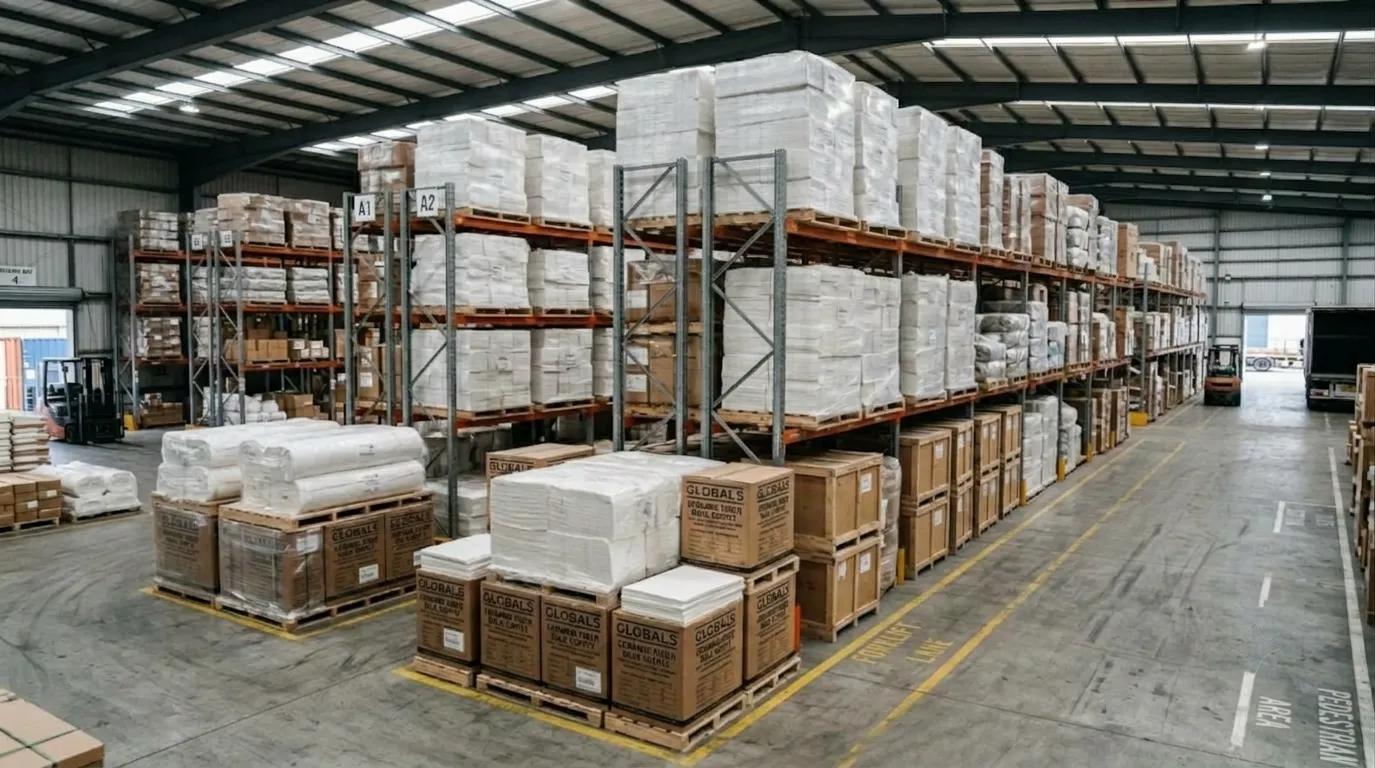
- Packing: moisture-proof inner bags with strong cartons or pallets for sea freight.
How to Choose the Right Ceramic Fiber Supplier from India
Use this checklist to separate genuine manufacturers from simple traders.
- Verify manufacturing capability. Ask about production capacity, number of lines and factory location. Request photos or a virtual audit.
- Ask for test reports. A serious supplier provides a batch-wise test certificate or Material Test Certificate (MTC) with each shipment.
- Request samples. Test a sample in your own application before placing a bulk order.
- Check quality certifications. Look for ISO 9001 and any other relevant management or product certifications.
- Review export experience. Experienced exporters understand incoterms, documents and container loading for your region.
- Compare communication and response time. Clear, quick, technical answers usually reflect how the company will behave after the order.
- Check references. Ask for past export destinations or customer references.
If you want to know more about the company behind this guide, read about Handmada.
Export Documents and Shipping from India
A smooth export needs correct paperwork. Typical documents include:
- Commercial invoice and packing list
- Bill of lading or airway bill
- Certificate of origin (preferential, if applicable)
- Material test certificate
- Safety data sheet (SDS)
- Fumigation certificate for wooden pallets (ISPM-15 compliant packing)
Indian exporters must hold an Importer-Exporter Code (IEC), issued through the Directorate General of Foreign Trade (DGFT). Always confirm the correct HS code with your freight forwarder or customs broker, since classification for ceramic fiber products can vary by product form and destination country.
Orders are most commonly quoted on FOB, CIF or CFR terms. For a first order, many buyers prefer CIF so that the supplier manages freight to the destination port.
Safety and Regulatory Notes
Refractory ceramic fibers are classified as a suspected carcinogen category in some regions, including under European chemical regulations. This does not make them unsafe when handled correctly. Buyers should:
- Request the safety data sheet from the supplier
- Use proper PPE (respirator, gloves, long sleeves) during installation
- Follow local regulations for handling and disposal
If your market restricts RCF, ask about alternatives such as alkaline earth silicate (AES) low bio-persistent fibers.
Common Applications of Ceramic Fiber
Ceramic fiber insulation supplied from India serves many industries:
- Steel and metal processing: reheating furnaces, ladles and heat treatment furnaces
- Petrochemical and refineries: reformers, heaters, cracker furnaces
- Power generation: boilers, turbines, exhaust ducts
- Ceramics, glass and cement: kilns and regenerators
- Fire protection: fire doors, fire stops and passive fire safety
- Automotive and aerospace: heat shields and exhaust insulation
What Affects Ceramic Fiber Price?
Price varies by product and market, so avoid choosing on cost alone. The main factors are:
- Raw material cost (alumina, silica, zirconia)
- Grade and classification temperature
- Density and thickness
- Order quantity and packing requirements
- Freight, insurance and destination port
- Current exchange rates
The cheapest quotation often hides low density, high shot content or thin rolls, so always compare on the same specifications.
Why Work with Handmada as Your Ceramic Fiber Supplier
Handmada supports global buyers with export-ready industrial products and a transparent, quality-first approach. When you source ceramic fiber from us, you can expect:
- Product options across blankets, boards and related forms
- Clear specifications and test documentation
- Responsive communication and quote turnaround
- Export-grade packing and reliable logistics support
- Experience in global trade, as also seen in our guides on high-demand export products driving global trade
We also supply other products to international buyers. If you are importing in more than one category, explore our guides on the best SPC flooring manufacturer from India and the best FIBC bag manufacturer, or browse everything on our products page.
Frequently Asked Questions
Who is the best ceramic fiber supplier from India?
The best supplier is one that manufactures to consistent specifications, provides batch test certificates, offers samples and has proven export experience. Compare at least three suppliers on density, shot content, shrinkage and delivery time, not only price.
What is the minimum order quantity for ceramic fiber from India?
MOQ depends on the supplier and product. Many Indian exporters accept trial orders or mixed-product loads, while full container loads give the best price per kg. Contact the supplier for current MOQ details.
Is ceramic fiber from India as good as European or American brands?
When produced with quality raw materials and tested properly, Indian ceramic fiber can meet the same performance requirements at a more competitive cost. Always request a test report and a sample to verify.
Which ceramic fiber grade should I choose?
Choose the grade by your maximum operating temperature with a safety margin. Standard and High Purity (1,260 °C) suit most furnaces, High Alumina (1,360 °C) suits more demanding processes, and Zirconia (1,430 °C) suits very high temperature applications.
How long does export delivery take?
Production usually takes a few days to a few weeks depending on quantity, and sea freight transit varies by destination. Ask your supplier for a written delivery schedule when confirming the order.
Can ceramic fiber be customised?
Yes. Thickness, density, roll size and packing can usually be customised to suit your market and application.
Conclusion
Choosing the right ceramic fiber supplier from India means looking at quality, documentation, export experience and service, in addition to price. With the right partner, you get reliable high-temperature insulation that improves energy efficiency and protects your equipment for years.
Ready to compare options? Explore our ceramic fiber range, then contact the Handmada team with your grade, density and quantity to receive a detailed quotation and samples.