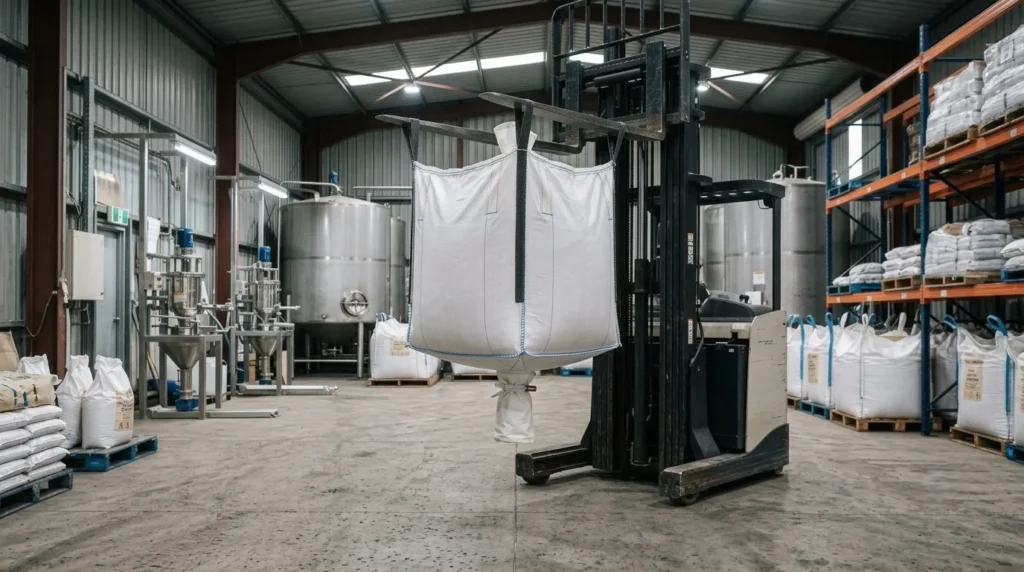
Choosing an FIBC bag is not simply about finding a bag that can hold a particular quantity of material. The product inside the bag, filling method, discharge process, storage conditions, transportation requirements, and handling equipment all influence which specification is appropriate.
For manufacturers, importers, distributors, and industrial buyers, selecting the right FIBC bag for bulk material can make everyday handling more organized and help avoid problems during filling, transportation, storage, and unloading.
This guide explains the key factors to consider before ordering FIBC bags for different bulk materials.
Start With the Material You Need to Pack
The first question to ask is simple: What will the FIBC bag contain?
Different materials behave differently when packed. A free-flowing granule may move easily through a discharge outlet, while a fine powder can behave differently during filling and emptying.
Before selecting a bag, consider:
- Material name and type
- Powder, granule, flake, or other physical form
- Bulk density
- Moisture sensitivity
- Flow characteristics
- Temperature during filling
- Sensitivity to contamination
- Whether the material can generate static electricity
These details provide the foundation for selecting the appropriate bag construction and accessories.
Consider the Bulk Density of the Product
Bulk density is an important specification when choosing an FIBC.
Two products can occupy the same volume but have significantly different weights. This means that choosing a bag only by its dimensions may not provide enough information about its actual load requirement.
For example, a lightweight agricultural product and a dense mineral material may require very different specifications even if both are packed into similarly sized containers.
Providing the product’s approximate bulk density to your FIBC supplier can help determine an appropriate bag capacity and construction.
Determine the Required Bag Capacity
Once the material is understood, determine how much product needs to be packed into each bag.
FIBC bags are available in different capacities and dimensions, so the required quantity per bag should be established before discussing the final design.
Think about:
- Target weight per bag
- Product density
- Available warehouse space
- Container loading requirements
- Pallet or stacking arrangement
- Filling equipment
- Handling equipment
A bag that is too large for the intended application can create unnecessary storage challenges, while an undersized bag may require more units for the same shipment.
Choose a Construction That Matches the Application
FIBC construction influences how the bag behaves when filled and handled.
The bag may need a particular construction depending on the desired shape, stability, lifting method, and storage arrangement.
For example, buyers may consider different body constructions when they need:
- Better shape retention
- More efficient stacking
- Specific dimensions
- Compatibility with automated filling systems
- Easier handling with forklifts or lifting equipment
The goal is not to select the most complicated design. It is to select a construction that works with the actual handling process.
Check How the Bag Will Be Filled
The filling process should be considered before finalizing the FIBC specification.
Ask how the material enters the bag and what equipment is used. Some operations rely on automated filling lines, while others use manual or semi-automatic systems.
The top configuration can be selected according to the filling method. Depending on the application, buyers may require an open top, filling spout, or another customized arrangement.
A good filling design can make the packaging process smoother and reduce unnecessary handling.
Think About How the Bag Will Be Discharged
The bottom of an FIBC is just as important as the top.
If the material needs to be emptied directly into a processing machine, hopper, conveyor, or another container, the discharge arrangement should match the equipment.
Before ordering, determine:
- Where the product will be discharged
- How quickly it needs to flow
- Whether controlled discharge is required
- What equipment receives the material
- Whether the bag needs a specific outlet design
Matching the discharge system to the downstream process can make unloading more practical.
Decide Whether an Inner Liner Is Required
Not every bulk material requires a liner, but some applications benefit from one.
An inner liner can provide an additional barrier between the product and the woven polypropylene fabric. This may be useful when dealing with materials that are sensitive to moisture, contamination, leakage, or product loss.
Liners can be particularly relevant when the packed product has specific hygiene or protection requirements.
The liner should be selected according to the characteristics of the material rather than added automatically to every bag.
Consider Moisture and Environmental Conditions
Where and how the FIBC will be stored can influence its specification.
If the product is sensitive to moisture, the packaging system may need additional protection. Buyers should consider whether bags will be stored indoors, outdoors, during transportation, or in environments with changing humidity.
Other environmental factors may include:
- Exposure to sunlight
- Temperature variations
- Humidity
- Rain or water exposure
- Long-distance transportation
- Extended warehouse storage
Understanding the complete storage and transportation environment helps determine whether additional protective features are required.
Evaluate Static Electricity Requirements
Some bulk materials can create electrostatic charges during filling, movement, or discharge.
This is especially important when handling certain powders or materials in environments where flammable atmospheres may be present.
In such cases, the electrical properties of the FIBC become an important part of the specification. Buyers should provide details about the material and operating environment so the appropriate safety requirements can be considered.
For applications involving electrostatic hazards, the bag should be selected according to applicable standards and the complete handling system.
Match the FIBC to Your Handling Equipment
An FIBC may be lifted, moved, stored, or emptied using different types of equipment.
Before ordering, consider the equipment used at your facility and throughout the supply chain.
For example:
- Forklifts may require compatible lifting arrangements
- Crane systems may use lifting loops
- Automated systems may require specific bag dimensions
- Storage racks may have height or width restrictions
- Filling machines may require specific top configurations
- Discharge equipment may require a compatible bottom outlet
A bag specification should work with the entire material handling process, not just the packaging stage.
Consider Storage and Stacking Requirements
Warehouse space is often an important factor for bulk packaging.
If filled bags need to be stacked, the stability and shape of the FIBC become more important. Buyers should consider the available floor area, stacking height, storage duration, and handling frequency.
The packaging design can also influence how efficiently bags fit within a warehouse or shipping container.
If maximizing storage space is a priority, discuss the expected filled dimensions and stacking arrangement with the supplier before placing the order.
Review Safety Factor and Working Load
The safe working load, often referred to as SWL, is an important part of FIBC specifications.
The required SWL should be determined according to the intended filling weight and handling conditions. The bag also needs to be suitable for the way it will be lifted, transported, and stored.
Do not select an FIBC based only on its stated volume. Weight, lifting conditions, repeated handling, and applicable safety requirements should all be considered.
For regulated or higher-risk applications, buyers should also confirm the required testing and certification.
Check Food, Chemical, or Regulatory Requirements
The industry in which the FIBC will be used can introduce additional requirements.
Food ingredients may require suitable hygiene controls and food-contact materials. Chemical applications may require particular material compatibility or safety documentation. Certain regulated materials can require specific packaging certification.
Before requesting a quotation, identify whether your product falls under any industry-specific packaging regulations.
This allows the supplier to work from the correct specification from the beginning.
Think About Transportation and Container Loading
FIBC bags are often used for international bulk shipments, so transportation should be part of the planning process.
Consider how the bags will be loaded into:
- Shipping containers
- Trucks
- Warehouses
- Pallet systems
- Export packaging units
The filled dimensions, bag arrangement, stacking method, and total shipment weight can all affect how efficiently the shipment is organized.
For international buyers, discussing container loading requirements early can help avoid changes to the bag dimensions later.
Define Printing and Identification Requirements
FIBC bags can also be used as a practical way to identify the packaged material.
Depending on the application, buyers may require printing such as:
- Product name
- Batch information
- Handling instructions
- Company branding
- Safety information
- Product identification
The amount and placement of printing should be agreed upon before production so the final bag matches the buyer’s operational requirements.
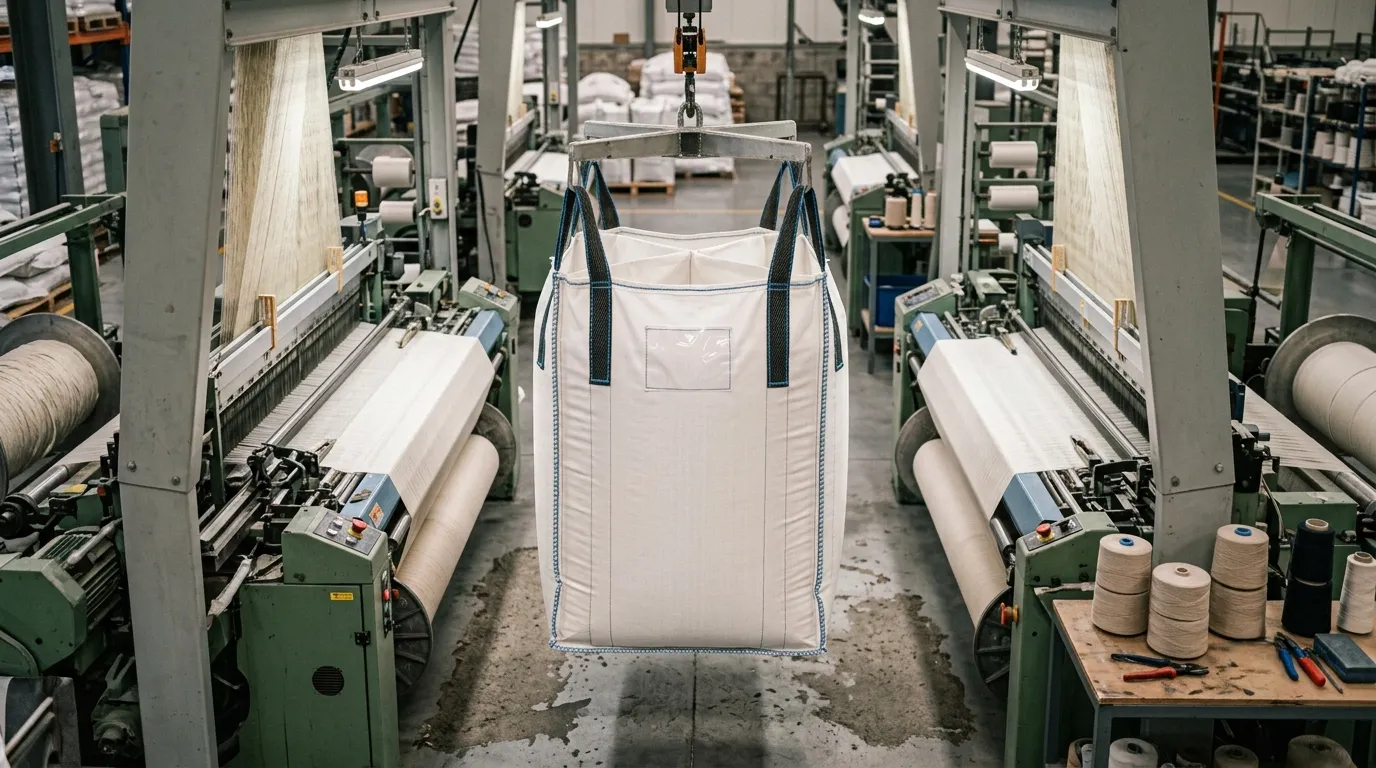
Create an FIBC Specification Before Ordering
One of the easiest ways to avoid confusion is to prepare a basic specification sheet before contacting an FIBC supplier.
Your specification can include:
|
Requirement |
Information to Confirm |
|
Product |
Material being packed |
|
Product form |
Powder, granule, flake, etc. |
|
Bulk density |
Approximate density |
|
Filling weight |
Target weight per bag |
|
Bag dimensions |
Required filled or flat dimensions |
|
Construction |
Required body design |
|
Top |
Filling configuration |
|
Bottom |
Discharge configuration |
|
Liner |
Required or not required |
|
Lifting |
Required loop arrangement |
|
Safety |
SWL and safety requirements |
|
Printing |
Artwork and identification |
|
Certification |
Applicable standards |
|
Quantity |
Order quantity |
|
Destination |
Shipping market |
Having this information ready makes it easier to compare quotations and discuss the right specification with a supplier.
Common Mistakes When Selecting an FIBC Bag
A few simple mistakes can lead to an unsuitable bulk bag.
Choosing Only by Size
A bag’s dimensions do not tell the complete story. Product density and filling weight should also be considered.
Ignoring the Discharge Process
A bag may work well during filling but become difficult to empty if the bottom configuration does not match the receiving equipment.
Adding Unnecessary Features
Additional liners, coatings, special constructions, or customized components can increase complexity and cost. Each feature should have a clear purpose related to the application.
Not Considering the Supply Chain
The bag needs to work during filling, storage, transportation, lifting, and final discharge. Looking only at the factory filling process can overlook problems later in the supply chain.
Providing Incomplete Specifications
A quotation based on limited information may not accurately represent the bag required for the final application. Sharing the material, weight, dimensions, handling process, and destination market gives the supplier a better starting point.
Working With an FIBC Bag Supplier
For international sourcing, communication is an important part of the buying process.
A reliable specification discussion should cover the product, bag construction, capacity, accessories, testing, packaging, quantity, lead time, and shipping requirements.
Handmada works with global buyers looking for FIBC bags based on specific bulk material handling requirements. Buyers can discuss product characteristics, bag dimensions, construction, filling and discharge configurations, liners, printing, and other specifications before finalizing an order.
Providing complete requirements at the enquiry stage can help create a clearer sourcing process from product selection through shipment.
Frequently Asked Questions
How do I choose the right FIBC bag?
Start with the material being packed, its bulk density, required filling weight, filling and discharge process, storage conditions, handling equipment, and any safety or certification requirements. These factors can then be used to develop the appropriate FIBC specification.
What information should I give an FIBC supplier?
Provide the product type, physical form, bulk density, target filling weight, bag dimensions, filling and discharge requirements, liner requirements, lifting method, quantity, printing needs, certification requirements, and destination market.
Does bulk density affect FIBC bag selection?
Yes. Bulk density affects how much material occupies a given volume and therefore influences the required bag capacity and dimensions.
Do all FIBC bags need an inner liner?
No. A liner is application-dependent. It may be useful when the material requires additional protection from moisture, contamination, leakage, or contact with the woven fabric.
How do I choose the right FIBC discharge outlet?
Consider where and how the material will be emptied. The discharge design should be compatible with the receiving equipment and the desired flow or unloading process.
Are FIBC bags suitable for international shipping?
Yes. FIBC bags are widely used for transporting dry bulk materials, including in international supply chains. The bag specification, packing arrangement, loading method, and applicable regulations should be confirmed for the intended shipment.
Can FIBC bags be customized?
Yes. Depending on the application, FIBC bags can be specified with different dimensions, construction styles, lifting arrangements, filling and discharge configurations, liners, coatings, and printing.
Conclusion
Choosing the right FIBC bag for bulk material starts with understanding the product rather than choosing a standard bag from a catalogue. Material characteristics, bulk density, filling weight, discharge method, liner requirements, handling equipment, storage conditions, safety considerations, and transportation all play a role in the final specification.
For buyers, the most useful approach is to document these requirements before requesting quotations. A detailed specification gives the supplier a clearer understanding of the application and makes it easier to develop an FIBC solution around the actual bulk handling process.
Whether the requirement is for agricultural products, industrial powders, minerals, food ingredients, chemicals, or other dry bulk materials, careful specification can help create a packaging solution that fits the way the product is handled from filling to final discharge.
Follow Us On: Instagram | LinkedIn | X (Twitter) | Facebook | YouTube | Pinterest