If you are searching for a dependable FIBC bag exporter from India, you are probably comparing price, quality, certifications and delivery timelines across many suppliers. India has become one of the world’s leading sources of Flexible Intermediate Bulk Containers (FIBCs), also called jumbo bags, bulk bags or big bags, thanks to its strong polypropylene supply chain, skilled textile workforce and competitive pricing.
In this guide, you will learn what FIBC bags are, which types exist, what specifications matter, how the export process works, and how to pick the right exporter for your business.
What Is an FIBC Bag?
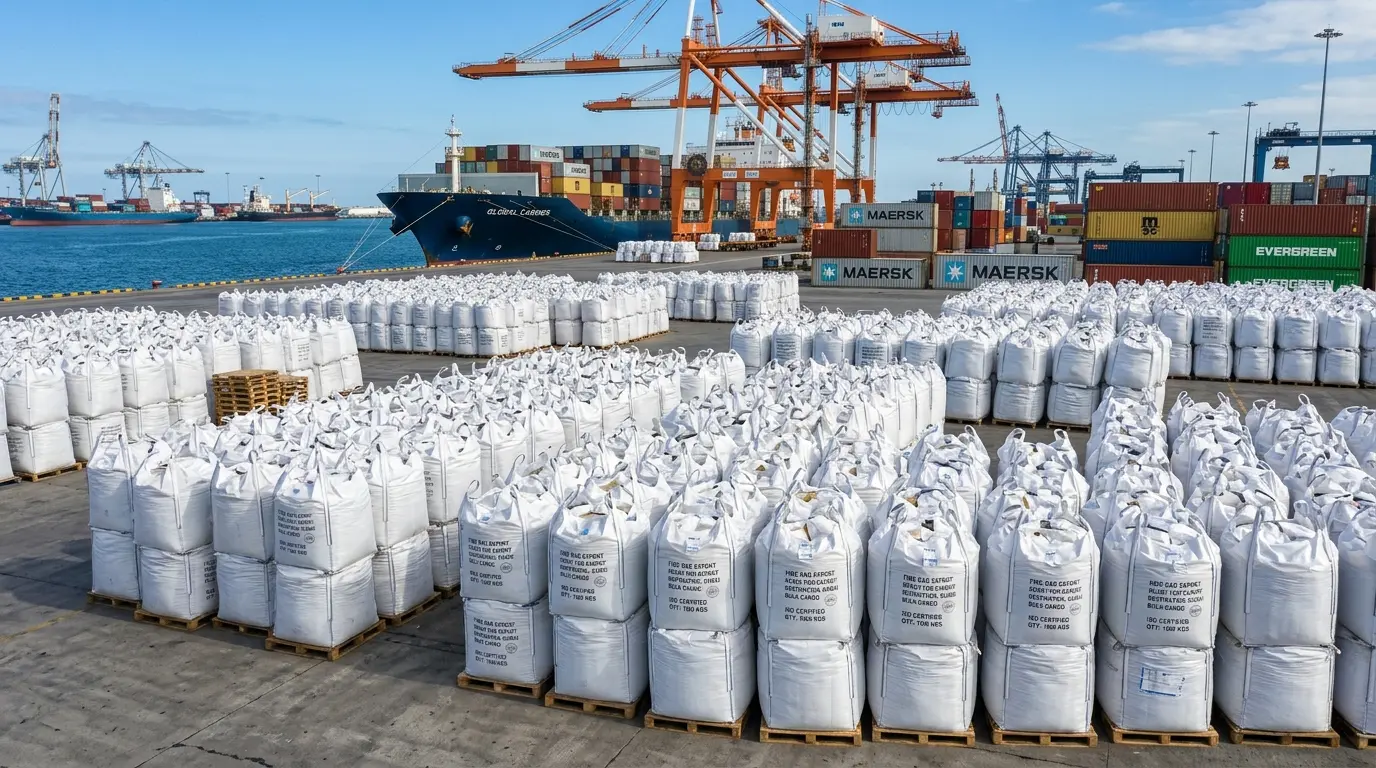
An FIBC (Flexible Intermediate Bulk Container) is a large woven polypropylene bag designed to store and transport dry, flowable materials such as grains, sand, cement, chemicals, fertilizers, minerals, food ingredients and powders. Standard bags usually hold between 500 kg and 2,000 kg, though custom sizes are possible.
FIBC bags replace small sacks and drums, which cuts handling time, labour cost and packaging waste. You can read the general definition on Wikipedia’s FIBC page. To see how they compare with traditional packaging, read our article on FIBC bags vs regular bags.
Why Import FIBC Bags From India?
India is a preferred sourcing destination for bulk packaging for several reasons:
- Cost advantage. Local access to polypropylene and low production costs give importers competitive pricing without compromising strength.
- Large manufacturing capacity. Indian factories handle both small trial orders and container-load volumes.
- Customization. Size, loop style, spout, liner, printing and fabric GSM can all be tailored.
- Export experience. Established exporters are familiar with documentation, palletizing and container loading for markets in Europe, the USA, the Middle East, Africa, Australia and Southeast Asia.
- Government support for exporters. India’s export ecosystem, including policies by DGFT, supports smooth international trade. You can also explore our article on high-demand export products driving global trade.
Types of FIBC Bags Exported From India
Choosing the right type depends on what you store and where you use it. A good FIBC bag exporter from India should offer all the major categories:
- Standard (Type A) FIBC. For non-flammable products. No static protection.
- Type B FIBC. Made from low-breakdown-voltage fabric to prevent dangerous sparking discharges.
- Type C (Conductive) FIBC. Must be properly grounded. Used for flammable powders and solvent-rich environments.
- Type D (Dissipative) FIBC. Safely dissipates static without grounding.
- Baffle bags (Q-bags). Internal baffles keep the bag square, which saves container space.
- Container liner bags. Used to ship bulk powders and granules inside a 20 ft or 40 ft container.
- UN-certified FIBCs. Tested for transporting certain dangerous goods.
- Food-grade FIBCs. Produced in clean conditions with liners for food and pharma ingredients.
For a deeper breakdown, see our detailed guide on the types of FIBC bags.
Key Specifications to Check Before Ordering
Before you request a quote from any exporter, define the following:
Specification | What to Specify |
Safe Working Load (SWL) | 500 kg, 1,000 kg, 1,500 kg, 2,000 kg or custom |
Safety Factor (SF) | 5:1 for single-use, 6:1 for multi-use bags |
Dimensions | Length × width × height in cm |
Fabric GSM | Typically 150 to 220 GSM, depending on load |
Top design | Open top, duffle (skirt) top or spout top |
Bottom design | Flat bottom or discharge spout |
Loops | Cross-corner or 4-loop; loop height and strength |
Liner | LDPE or HDPE, loose or form-fit |
Coating / lamination | For moisture and dust protection |
UV treatment | Needed for outdoor storage |
Printing | Brand logo, handling symbols, batch details |
Not sure about the load? Our article on how much weight an FIBC bag can hold explains safe working load and safety factor in simple terms. You can also follow our step-by-step guide on how to choose the right FIBC bag.
Certifications a Reliable FIBC Exporter Should Have
International buyers should ask for proof of quality and compliance. Look for:
- ISO 9001 quality management certification
- Compliance with ISO 21898, the international standard for FIBCs for non-dangerous goods (see ISO.org)
- UN certification for dangerous goods packaging (if required)
- Electrostatic testing reports for Type B, C and D bags (per IEC 61340-4-4, see IEC)
- Food-safety certification (BRC, FSSC or equivalent) for food-grade bags
- Third-party cyclic top-lift and drop test reports
Note for Handmada team: replace/add only the certifications Handmada actually holds. Do not claim any certificate that is not valid.
How Are FIBC Bags Manufactured?
Understanding manufacturing helps you judge quality. In short, the process includes:
- Polypropylene granules are extruded into tapes.
- Tapes are woven into fabric on circular looms.
- Fabric is coated or laminated (if needed).
- Panels are cut, printed and sewn.
- Loops, spouts and liners are attached.
- Bags go through strength, stitching and visual inspection.
- Finished bags are pressed, bundled and palletized.
Read the full process in how FIBC bags are manufactured.
FIBC Bag Export Process: Step by Step
A professional FIBC bag exporter from India will guide you through each stage:
- Enquiry and specification sharing. You share product type, bag size, SWL, quantity and destination port.
- Quotation and sample. The exporter sends a price quote, and a sample is made for approval.
- Order confirmation and advance payment. Typically by T/T or L/C.
- Production. Manufacturing starts after artwork and specification sign-off.
- Quality inspection. In-house checks or third-party inspection (SGS, Bureau Veritas, Intertek, etc.).
- Packing and palletizing. Bales are compressed to cut freight cost.
- Documentation. Commercial invoice, packing list, bill of lading, certificate of origin and test reports.
- Shipping. FOB, CIF or CFR from ports such as Mundra, Kandla, Nhava Sheva (JNPT) or Chennai.
- Delivery and after-sales support.
Typical lead time ranges from 2 to 4 weeks after approval, depending on quantity and customization (confirm exact figures with Handmada’s production team before publishing).
What Affects FIBC Bag Price?
Prices change with raw material rates, so always request a current quote. The main factors are:
- Polypropylene (PP) price movement
- Bag size and fabric GSM
- Coating, UV treatment and liner
- Type (Type A is cheapest; B, C, D and UN are higher)
- Printing and branding
- Order quantity and packing method
- Freight, port and incoterms
Ordering in full-container quantities usually brings the best per-unit rate.
How to Choose the Best FIBC Bag Exporter From India
Use this checklist before you finalize any supplier:
- Own manufacturing unit, not just a trading company
- Valid certifications and test reports
- Sample policy and quality assurance process
- Customization capability
- Export experience in your target country
- Transparent pricing and clear payment terms
- Consistent lead times and good communication
- References or client feedback
You can also compare criteria in our article on the best FIBC bag manufacturer and our overview of FIBC bag suppliers from India.
Industries That Use Indian FIBC Bags
- Agriculture and grains
- Fertilizers and chemicals
- Cement and construction materials
- Minerals, sand and aggregates
- Food ingredients, sugar and flour
- Pharmaceuticals
- Plastics and polymer granules
- Recycling and waste management
Why Choose Handmada as Your FIBC Bag Exporter From India?
Handmada supplies FIBC bags for importers and bulk-material businesses worldwide, with a focus on quality, customization and on-time delivery. Here is what you can expect:
- A wide range of FIBC bags built to your specification
- Support in selecting the right SWL, type and liner
- Quality checks before every shipment
- Clear export documentation and shipping support
- Competitive pricing for container-load orders
Learn more about Handmada or explore our full FIBC bag product range.
Frequently Asked Questions (FAQs)
- Who is the best FIBC bag exporter from India?
The best exporter is one with its own manufacturing facility, valid ISO/UN certifications, strong export experience and transparent communication. Always request samples and test reports before placing a bulk order. - What is the minimum order quantity (MOQ) for FIBC bags?
MOQ varies by exporter and customization level. Many exporters accept trial orders, while full-container orders get the best pricing. Contact Handmada for current MOQ. - How much weight can an FIBC bag hold?
Most FIBC bags carry 500 kg to 2,000 kg. The exact limit depends on fabric, stitching and the safety factor (5:1 or 6:1). - Can FIBC bags be customized?
Yes. Size, SWL, loops, spout, liner, coating, UV protection and printing can be customized. - Which FIBC type is safe for flammable powders?
Type C (grounded) and Type D (static-dissipative) bags are designed for such environments. Always follow your local safety regulations. - How many FIBC bags fit in a 40 ft container?
It depends on bag size and whether they are baled. As a rough guide, tens of thousands of flat folded empty bags can fit in a 40 ft container. Ask your exporter for an exact loading plan. - Which documents are required to import FIBC bags from India?
Commercial invoice, packing list, bill of lading, certificate of origin and test or certification reports. Your local customs authority may require additional papers.
Get a Quote From a Trusted FIBC Bag Exporter in India
Looking for a reliable FIBC bag exporter from India? Share your required size, load capacity, quantity and destination port, and our team will send you a detailed quote and sample options.
Contact Handmada today to get started.