Two SPC planks can look the same in a photo and behave very differently once they’re on your floor. The right choice depends on your project: who walks on it, what’s underneath it, which room it’s in and what you need from the design.
This guide shows how to choose SPC flooring step by step, whether you’re renovating a flat, building a villa or fitting out an office or shop. If you want the basics first, read what SPC flooring is and its benefits, features and applications. Here, we focus on making the decision.
Quick answer: Choose SPC flooring by matching four things: (1) the wear layer to your foot traffic, (2) the thickness to your subfloor and floor height, (3) the core and click-lock quality to how long you want it to last, and (4) the design to your light and furniture. Always check a physical sample before you order.
Step 1: Start with your project type
Different projects put different demands on a floor. Use this table as a starting point, then refine it with the steps below.
|
Project |
What matters most |
Spec direction |
|
Apartment or flat renovation |
Limited floor height, quick fitting, noise rules in the building |
4–5 mm thickness, 0.3–0.5 mm wear layer, attached underlay |
|
Family home or villa |
Mixed traffic, children, pets, furniture |
5–6 mm thickness, 0.5 mm wear layer |
|
New construction |
Full control of the subfloor, large areas |
5–8 mm thickness, plan accessories early |
|
Office or co-working space |
Rolling chairs, constant footfall |
0.5–0.7 mm wear layer, commercial rating |
|
Retail shop or showroom |
Heavy traffic, strong visual impact |
0.7 mm wear layer, durable surface texture |
|
Café or restaurant |
Spills, frequent cleaning, grip |
0.5–0.7 mm wear layer, textured finish, tight joints |
|
Clinic or salon |
Hygiene, easy cleaning |
0.5 mm or higher wear layer, tight joints, sealed edges |
|
Rental property |
Fast turnaround, durability, neutral look |
0.5 mm wear layer, matte neutral tones |
These are general guidelines, so always check the manufacturer’s data sheet for each product’s rated use.
Step 2: Match the wear layer to foot traffic
The wear layer is the clear protective film above the printed design. It takes scratches, scuffs and daily wear, so it is the most important number for how long the floor keeps its look.
- 0.3 mm (about 12 mil): bedrooms, guest rooms and light-use spaces
- 0.5 mm (about 20 mil): living rooms, kitchens, hallways and light commercial areas
- 0.7 mm (about 28 mil) and above: shops, offices, restaurants and other busy spaces
If you are unsure, go one step up. A thicker wear layer is the simplest way to protect the floor against the unexpected.
Step 3: Check your subfloor and floor height
Your base decides how forgiving the floor needs to be.
- Flat and dry subfloor: most SPC thicknesses work well.
- Slightly uneven subfloor: a thicker, denser plank hides minor imperfections better, but it will not fix real unevenness. Level the surface first.
- Limited height (doors, thresholds, existing floors): choose a thinner plank so doors still open and transitions stay neat.
- Concrete floors: these must be fully cured and moisture-tested, with a moisture barrier where recommended.
- Existing tiles: SPC can often be laid over them if they are firmly bonded and level. Fill deep grout lines first.
As a rule of thumb, the subfloor should be flat within the manufacturer’s tolerance (often about 3 mm over 2 metres).
Step 4: Judge the core quality
You can’t see core quality in a photo, but you can check it in a sample:
- Edges and cut surface: they should look clean, solid and even, with no crumbling or hollow spots.
- Thickness consistency: measure a few planks, as they should match.
- Rigidity: the plank should resist bending and feel dense for its size.
- Flatness: lay a plank on a flat surface and check that it doesn’t curl at the corners.
A good rigid core is what keeps the floor stable and resistant to dents from furniture and heavy use.
Step 5: Examine the click-lock system and underlay
The locking profile holds your floor together for years. Click two sample planks together and check that:
- They lock firmly with no gaps along the length or at the ends.
- They don’t separate with light pressure.
- The profile is the same on all sides, so installation is easy.
If the plank already has an attached underlay (usually a thin IXPE or EVA foam backing), it adds comfort and softens footstep noise, which is useful in apartments and offices. Don’t add another underlay on top unless the manufacturer allows it, because stacked layers can weaken the joints.
Step 6: Think about the room conditions
Look at the specific conditions in each space:
- Bathrooms and kitchens: SPC does not absorb water, but standing water can still reach the edges. Seal the perimeter and fixture cut-outs with silicone and ventilate the room.
- Rooms with underfloor heating: SPC generally works, but surface temperature is typically capped at around 27°C. Check the data sheet and raise the heat gradually.
- Sunny rooms: strong direct sun can heat the surface and fade colours over time, so use blinds or curtains for large south-facing windows.
- Humid or coastal areas: choose a tight click system and keep a proper expansion gap.
- Noise-sensitive spaces: pick a plank with an attached underlay.
- Outdoors: SPC is designed for interiors and is not suitable for open balconies or terraces exposed to rain and sun.
Step 7: Choose the design with your space in mind
Design is the fun part, but a few practical points will keep you happy for years:
- Tone: medium wood tones are the easiest to live with. Very dark and very light colours show dust and scratches more.
- Finish: matte, low-gloss surfaces hide footprints better than glossy ones.
- Texture: embossed-in-register textures follow the printed grain, look more natural and add grip.
- Plank size: wide and long planks make a room feel larger, while narrower planks suit smaller rooms and traditional layouts.
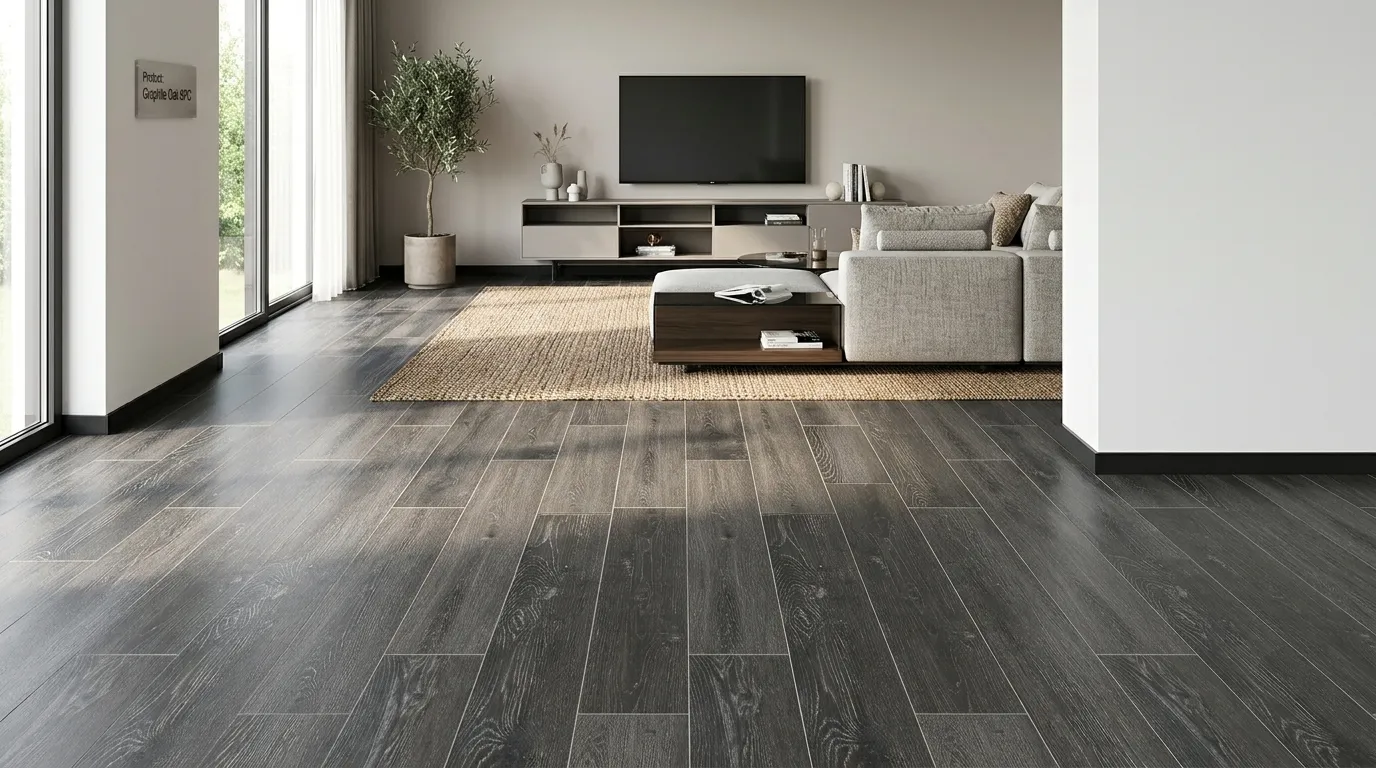
- Look: wood-look suits homes and offices, and stone-look or marble-look suits showrooms, lobbies and modern kitchens.
- Light: always view the sample in your own lighting, both daylight and evening.
You can browse available designs on our SPC flooring page.
Step 8: Plan quantity and accessories
Before you order, plan the full job:
- Measure each room, including alcoves and doorways.
- Add 5–10% extra for cuts and waste. Add up to 10% or more for diagonal or herringbone layouts.
- Buy everything in one batch so colour and finish match.
- List the accessories: skirting, reducers, end caps, T-profiles and stair nosing in matching colours.
- Keep a few spare planks for future repairs.
Step 9: Verify the supplier and documentation
A reliable supplier should provide:
- A technical data sheet with thickness, wear layer, core type, locking system and recommended use
- Physical samples
- Low-emission credentials, such as FloorScore, which relates to indoor air quality (see the EPA’s overview of indoor air quality)
- Clear warranty terms and installation guidelines
- Availability of matching accessories
For commercial projects, also ask about the product’s rated use class, which is based on international classification systems such as those published by ISO.
Step 10: Test the sample before you order
A simple sample test gives you more information than a brochure:
- Look at it in daylight and evening light.
- Click two planks together and check the joint.
- Gently scratch an offcut with a coin and see how it marks.
- Place a damp cloth on it and check it wipes clean.
- Lay it beside your skirting, doors and furniture colours.
When SPC may not be the best choice
SPC suits most interior projects, but consider another option if:
- You want a very soft, warm underfoot feel, in which case a thicker underlay or a softer-core vinyl may suit you better.
- You want real wood that can be sanded and refinished.
- The space is outdoors.
- The subfloor is badly damaged, damp or uneven and can’t be corrected first.
Common mistakes when choosing SPC flooring
- Choosing by photo alone without ordering a sample
- Ignoring the wear layer and looking only at total thickness
- Skipping subfloor preparation
- Not planning the expansion gap and skirting
- Forgetting accessories or buying them from a different batch
- Using a thin, low-traffic specification in a busy commercial area
- Adding a second underlay on top of an attached one
- Placing rubber-backed mats on the floor, which can stain vinyl
Quick checklist before you buy
- Project type and traffic level defined
- Wear layer matches the traffic
- Thickness suits the subfloor and door clearance
- Core and click-lock tested on a sample
- Room conditions checked (moisture, heat, sun, noise)
- Design viewed in your own lighting
- Quantity measured with extra for waste
- Accessories and spare planks planned
- Supplier documents and warranty checked
Frequently asked questions
What thickness of SPC flooring should I choose?
Most homes use 4–6 mm. Choose thinner planks when floor height is limited and thicker planks for a more solid feel or for slightly imperfect subfloors. Always read thickness together with the wear layer.
What wear layer is best for a home?
A 0.5 mm wear layer suits most living areas, while 0.3 mm is usually enough for bedrooms. Busy homes with pets or children benefit from 0.5 mm throughout.
Which SPC flooring is best for commercial spaces?
Look for a 0.5–0.7 mm wear layer or higher, a rated commercial use class, a strong locking system and a textured, matte surface.
Is SPC flooring good for bathrooms and kitchens?
Yes, because the core doesn’t absorb water. Seal the edges with silicone, wipe spills quickly and ventilate the room.
Can I install SPC flooring over existing tiles?
Often yes, if the tiles are firmly bonded and level. Fill deep grout lines first so they don’t show through.
Does SPC flooring work with underfloor heating?
Generally yes, within the temperature limit given by the manufacturer (typically around 27°C at the surface).
Do I need to acclimatise SPC planks?
SPC is dimensionally stable, but most manufacturers still recommend leaving the boxes in the room for 24–48 hours before installation.
How do I know I’m getting good quality SPC flooring?
Ask for a technical data sheet, check a physical sample for core density, edge quality and joint fit, and confirm warranty and certification details.
Final thoughts
The right SPC flooring is the one that fits your project: the correct wear layer for the traffic, the right thickness for your subfloor, a solid core and click system, and a design that works in your light. Take a sample, test it and plan your accessories, and your floor will look good and perform for years.
Ready to compare options? Explore Handmada’s SPC flooring collection or contact our team for samples and project advice.