Demand for waterproof, durable and low-maintenance flooring keeps growing, and SPC (Stone Plastic Composite) vinyl flooring is one of the fastest-growing categories in global trade. Importers, distributors, contractors and retail chains in the USA, Europe, the Middle East, Africa and Australia are now looking at India as a serious sourcing option.
If you are searching for an SPC vinyl flooring supplier from India, this guide covers what to check before you place an order: product specifications, quality control, certifications, pricing, MOQ, packaging and shipping. It will help you avoid costly sourcing mistakes.
Why Source SPC Vinyl Flooring from India?
India has become a competitive manufacturing base for rigid-core flooring for several reasons:
- Competitive pricing: Lower labour and operating costs, with growing local availability of PVC and calcium carbonate raw materials.
- Growing manufacturing capacity: More Indian factories are investing in modern extrusion, UV-coating and click-lock (I4F / Unilin-style) profiling lines.
- Supply chain diversification: Many buyers want an alternative to depending on a single country for sourcing.
- Customisation: Indian exporters are generally flexible with private labelling, custom decors, sizes and packaging.
- Port access: Major export ports such as Mundra, Nhava Sheva (JNPT) and Chennai give good access to global shipping routes.
For a broader look at the Indian manufacturing landscape, read our guide on the best SPC flooring manufacturer from India for global buyers.
What Is SPC Vinyl Flooring? (Quick Overview)
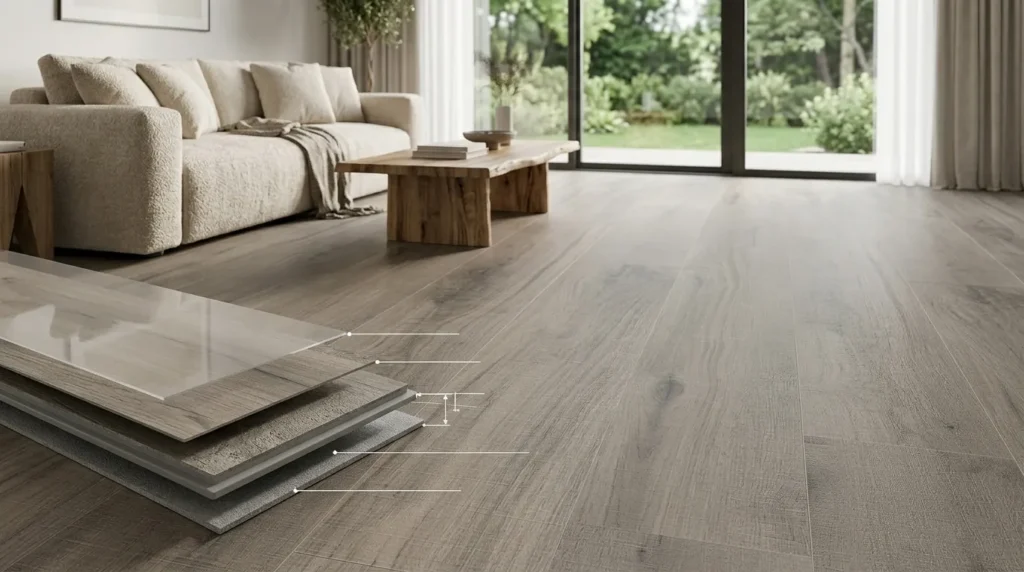
SPC stands for Stone Plastic Composite. It is a rigid-core vinyl plank made from a blend of limestone powder (calcium carbonate), PVC and stabilisers. A typical SPC plank has these layers:
- UV coating: protects against scratches and stains
- Wear layer: commonly 0.3 mm to 0.7 mm, depending on usage
- Printed decor film: wood, stone or marble look
- SPC rigid core: dense, stable and waterproof
- Underlay (IXPE/EVA, optional): reduces noise and improves comfort
If you are new to the product, start with our explainer on what SPC flooring is, and see the benefits, features and applications of SPC flooring.
Key Benefits Buyers Look For
- 100% waterproof core: suitable for kitchens, bathrooms and commercial spaces. Learn more in is SPC flooring waterproof?
- High dimensional stability: the dense core resists expansion and contraction with temperature changes.
- Dent and impact resistance: better than LVT and WPC in heavy-traffic areas.
- Easy click-lock installation: faster and cheaper to install. See how long SPC flooring takes to install and the SPC flooring cost to install.
- Low maintenance: no sanding, sealing or polishing.
8 Things to Check Before Choosing an SPC Vinyl Flooring Supplier from India
1. Manufacturing capability and capacity
Confirm whether the supplier is a manufacturer or a trader. Ask about monthly production capacity, the number of production lines and lead times. A real manufacturer can answer questions about raw material sourcing and process control without delay.
2. Product specifications
Always request a full technical datasheet. Key specs to compare:
Specification | Common Options |
Total thickness | 3.5 mm, 4 mm, 5 mm, 6 mm, 7 mm |
Wear layer | 0.3 mm, 0.5 mm, 0.7 mm |
Plank size | 1220 × 180 mm, 1220 × 228 mm, 1524 × 228 mm (custom available) |
Locking system | Click-lock (Unilin / Valinge style) |
Underlay | IXPE / EVA (1 mm to 1.5 mm) |
Finish | Embossed-in-register (EIR), matte, wood grain |
Use | Residential, light commercial, commercial |
Use our guide on how to choose SPC flooring to match thickness and wear layer to the application.
3. Raw material quality
Quality SPC uses virgin PVC resin and high-purity calcium carbonate. Cheap flooring often uses recycled material or too much filler, which causes brittleness, odour, colour fading and joint failure. Ask for the formulation approach and request a sample for a bend test and a heat test.
4. Certifications and compliance
Depending on your destination market, ask about:
- CE marking and EN 14041 compliance for Europe. See the European Commission CE marking guidance.
- REACH compliance (phthalate-free formulation). See the ECHA REACH overview.
- FloorScore or low-VOC emission testing for the USA. See SCS Global Services FloorScore.
- ISO 9001 quality management.
- Fire rating (for example Bfl-s1 for commercial projects).
5. Quality control and testing
Ask whether the supplier tests for:
- Dimensional stability
- Locking strength
- Abrasion resistance
- Scratch resistance
- Residual indentation
- Colour consistency between batches
Batch consistency matters because a mismatch between containers can ruin a large project.
6. Customisation and private labelling
If you are a distributor or brand owner, check for:
- Custom decor and design development
- Private label packaging and boxes
- Custom plank sizes and thickness
- Branded underlay and carton printing
7. MOQ, pricing and payment terms
Price depends on thickness, wear layer, underlay, design, packaging and order volume. Clarify these before comparing quotes:
- Minimum order quantity (usually per 20 ft or 40 ft container)
- Incoterms (FOB, CIF, CFR, DDP)
- Payment terms (T/T, L/C)
- Sample policy and sample cost
Never compare price alone. A quote that is 10% cheaper often reflects a thinner wear layer, a lower-density core or weaker packaging.
8. Packaging, logistics and export support
A good exporter will provide:
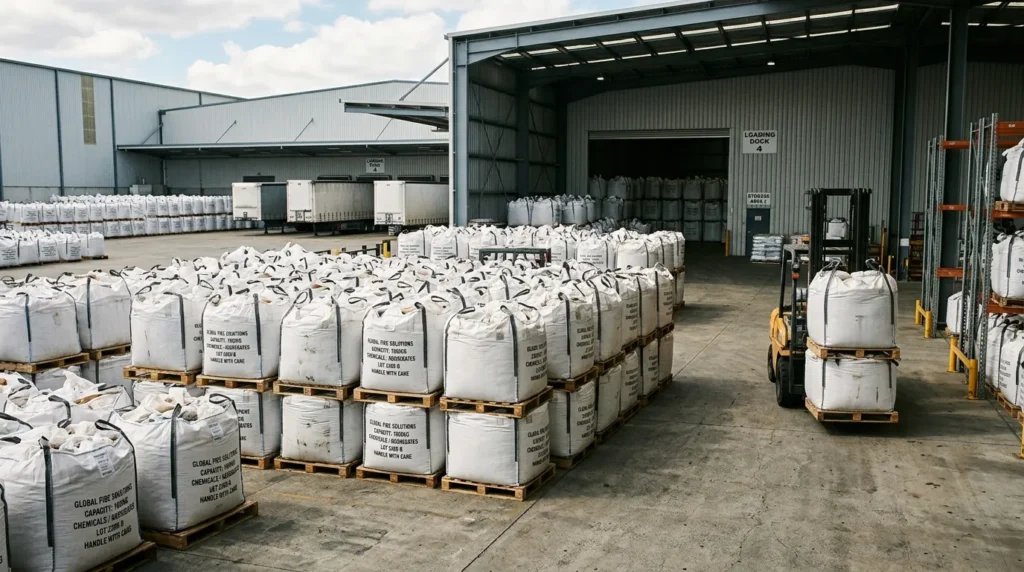
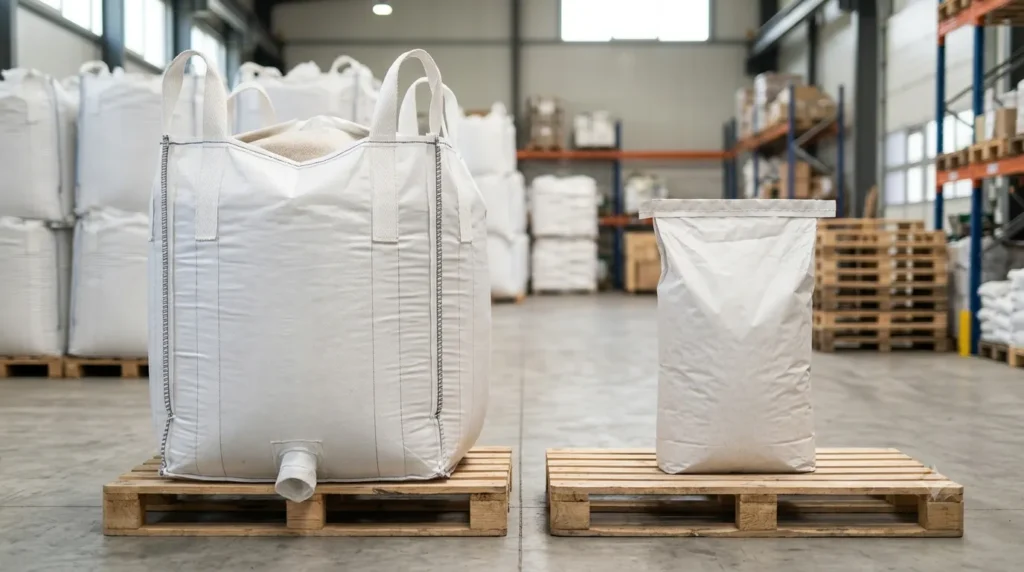
- Strong cartons and palletisation to prevent edge damage
- Container loading plans (a 20 ft container commonly carries roughly 2,000 to 2,600 sq m depending on thickness)
- Complete documentation: commercial invoice, packing list, certificate of origin, bill of lading
- Reliable shipping from major Indian ports
For official export procedures in India, refer to the Directorate General of Foreign Trade (DGFT).
Common Mistakes Importers Make
- Choosing only the lowest price: this often leads to thin wear layers and high claim rates.
- Skipping samples: always test samples for fit, locking and colour.
- Ignoring the wear layer: residential and commercial needs differ.
- Not verifying certifications: ask for valid test reports, not just claims.
- Dealing with traders: this can mean no control over quality and delivery.
SPC vs WPC vs LVT: Quick Comparison
Feature | SPC | WPC | LVT |
Core | Stone + PVC (rigid) | Wood/foam + PVC (softer) | Flexible vinyl |
Waterproof | Yes | Yes | Yes |
Dent resistance | High | Medium | Low to medium |
Comfort underfoot | Firm | Softer | Soft |
Heat stability | Excellent | Good | Fair |
Best for | Homes, offices, retail, hotels | Bedrooms, living rooms | Glue-down projects |
Applications of SPC Vinyl Flooring
- Residential homes and apartments
- Hotels and hospitality projects
- Retail stores and showrooms
- Offices and co-working spaces
- Hospitals and clinics
- Schools and educational institutions
- Rental and renovation projects
How Handmada Supports Global SPC Flooring Buyers
At Handmada, we help international buyers source quality SPC flooring from India with consistent specifications, dependable delivery and clear communication. You can explore our SPC flooring range, read more about Handmada, or browse more guides in our SPC flooring blog category.
Ready to request samples or a quote? Contact our export team with your target market, thickness, wear layer, quantity and design preferences.
Frequently Asked Questions
Q1. Why should I buy SPC vinyl flooring from India?
India offers competitive pricing, growing production capacity, customisation options and strong port connectivity. It is also a useful way to diversify your sourcing beyond a single country.
Q2. What is the MOQ for SPC flooring export from India?
MOQ varies by supplier and design. Many exporters work on a per-container basis (20 ft or 40 ft), and some allow mixed designs within one container. Confirm this with your supplier.
Q3. Which thickness is best for SPC flooring?
4 mm to 6 mm suits most residential and light commercial projects. Choose 0.5 mm to 0.7 mm wear layer for commercial or high-traffic areas.
Q4. Is SPC flooring really waterproof?
Yes. The rigid core does not absorb water. Water can still seep through gaps at edges and walls, so proper installation matters. Read our detailed answer in is SPC flooring waterproof?
Q5. How much does SPC flooring cost to install?
Cost depends on the subfloor condition, area and labour rates in your region. See our breakdown in SPC flooring cost to install.
Q6. Can I get private label SPC flooring from India?
Yes. Many manufacturers offer custom decors, branded packaging and private label services, usually with an MOQ.
Q7. How do I verify a supplier’s quality before ordering in bulk?
Order samples, request test reports and certificates, check batch consistency and, where possible, arrange a third-party pre-shipment inspection.
Conclusion
Choosing the right SPC vinyl flooring supplier from India comes down to manufacturing capability, raw material quality, certifications, customisation and dependable export support. Compare suppliers on the full picture, not only on price, and always test samples before committing to a bulk order.
Looking for a trusted SPC flooring partner? Contact Handmada today for samples, specifications and a competitive quote.