Demand for waterproof, durable and easy-to-install flooring is growing in the USA, Europe, the Middle East, Africa, Australia and Southeast Asia. SPC (Stone Plastic Composite) flooring is a major part of that growth. If you are an importer, distributor, contractor or brand owner, choosing the right SPC vinyl flooring exporter from India can decide your margins, product quality and delivery reliability.
This guide covers what to look for in an Indian exporter, which specifications matter, how pricing works, and how a typical export order moves from inquiry to delivery.
Why Source SPC Vinyl Flooring From India?
India has a strong base in PVC processing, tile manufacturing and export logistics, which suits SPC production and shipping. Buyers commonly choose Indian exporters for these reasons:
- Competitive pricing: access to raw materials, labor and manufacturing capacity helps keep factory costs reasonable.
- Customization: many Indian manufacturers offer OEM and private-label options, including custom sizes, embossing, colors and packaging.
- Port access: Gujarat and Maharashtra ports such as Mundra, Pipavav and Nhava Sheva (JNPT) have regular container services to major markets.
- Supply diversification: many importers want options beyond a single sourcing country.
- Government export support: India actively supports exports through trade policy and schemes. See the Directorate General of Foreign Trade (DGFT) for current export regulations and the India Brand Equity Foundation for industry and trade information.
What Is SPC Vinyl Flooring?
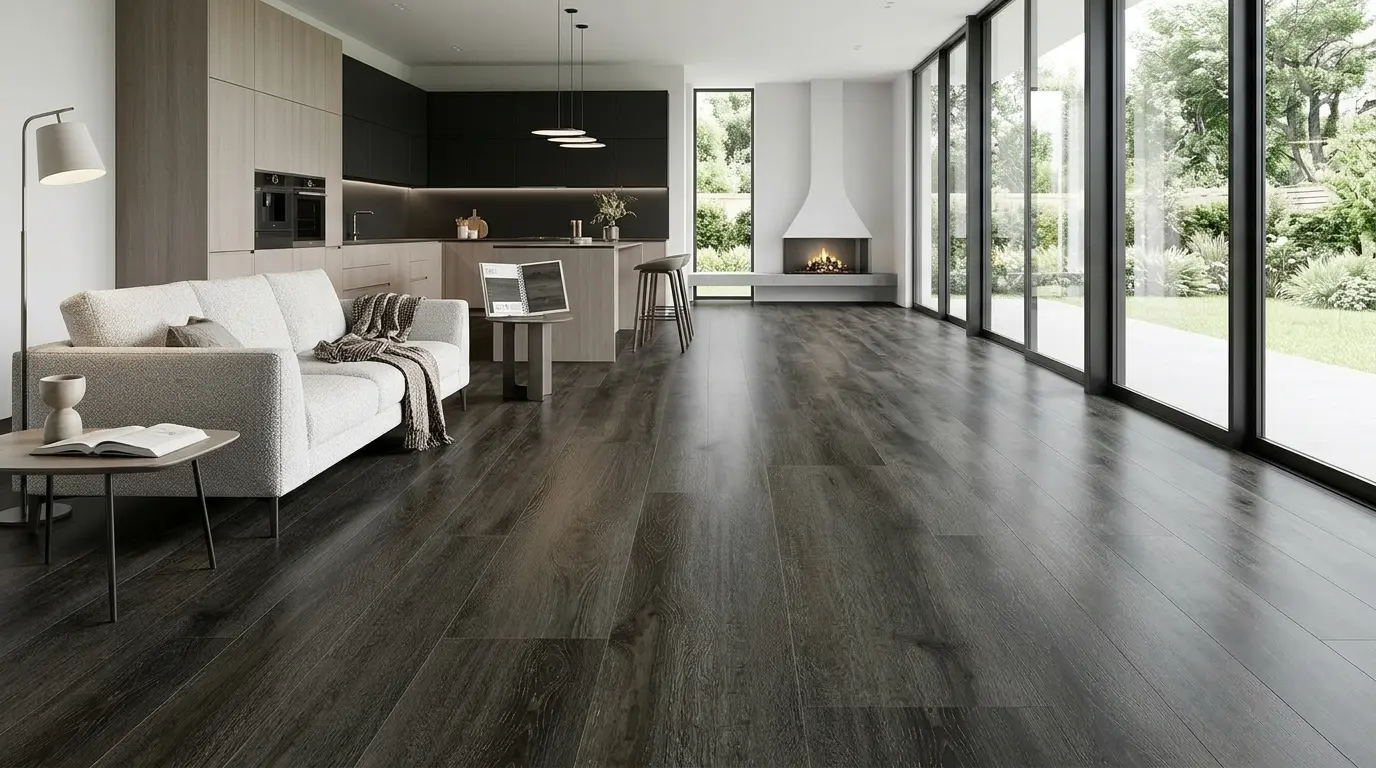
SPC flooring is a rigid-core vinyl floor made from limestone powder, PVC resin and stabilizers. The dense core makes it dimensionally stable, resistant to water, and hard to dent. Most SPC planks have four layers:
- UV coating for scratch and stain resistance
- Wear layer that protects the surface from daily traffic
- Printed décor film that gives the wood, stone or marble look
- Rigid SPC core with an attached underlay (IXPE or EVA) in many products
If you are new to the product, read our explainer on what is SPC flooring and its benefits, features and applications.
Key Specifications to Check Before Choosing an Exporter
A reliable exporter will share clear technical data, not just photos. Confirm these points before placing an order:
Specification | Typical Range / Option | Why It Matters |
Total thickness | 3.5 mm to 8 mm (4 to 6 mm most common) | Affects comfort, sound and subfloor tolerance |
Wear layer | 0.3 mm to 0.7 mm | Residential vs. light commercial use |
Locking system | Click-lock (drop-lock / angle-angle) | Faster installation, no glue needed |
Underlay | IXPE, EVA or none | Sound reduction and comfort |
Surface finish | Embossed in register, matte, wood grain, stone | Realistic look and slip resistance |
Plank size | 7″x48″, 9″x60″, 12″x24″ and custom | Market preference varies |
Phthalates / formaldehyde | Phthalate-free, low emissions | Required in many Western markets |
To pick the right build for your market, see our guides on the best thickness for SPC flooring and how to choose SPC flooring.
Certifications and Compliance Buyers Should Ask For
Compliance requirements depend on your destination market. A professional exporter should be able to discuss test reports and standards such as:
- ISO 9001 quality management certification
- Test reports for EN ISO 10582 / EN 14041 (resilient floor coverings and CE-related requirements for the European market)
- REACH compliance for chemical safety in the EU
- FloorScore or equivalent low-emission testing for the US market (see FloorScore)
- Fire, slip and wear classification reports where required by local regulations
Always ask for recent third-party lab reports and check that they cover the exact product you are buying, not a different series. Check the standards bodies for current requirements, for example the International Organization for Standardization (ISO).
How to Evaluate an SPC Vinyl Flooring Exporter From India
Not every supplier is a true manufacturer. Use this checklist:
- Factory or trader? Ask whether they manufacture or source. Request factory photos, videos or a virtual audit.
- Sample policy: a serious exporter provides samples so you can check the click system, wear layer and flatness.
- Quality control: ask about batch testing, thickness tolerance, and pre-shipment inspection.
- Export experience: check previous export markets, documentation capability and packaging standards.
- Customization ability: confirm design development, logo printing, carton design and private labeling.
- Communication: quick, clear and detailed replies usually reflect how the order will be handled.
- Consistency: ask how color and design consistency are controlled between production batches.
For a deeper comparison of sourcing options, read our guide on the best SPC flooring manufacturer from India and our overview of an SPC vinyl flooring supplier from India.
SPC Flooring Pricing: What Affects the Cost?
Prices change with raw material costs and freight, so any fixed number quickly becomes outdated. The main factors are:
- Thickness and wear layer: thicker boards and higher wear layers cost more.
- Raw material quality: virgin PVC resin and quality stabilizers affect durability and price.
- Design and printing: exclusive designs and registered embossing cost more.
- Underlay: attached IXPE or EVA adds cost.
- Order quantity: larger volumes typically bring better per-square-meter pricing.
- Packaging: private-label cartons and pallets add cost.
- Shipping terms: FOB, CIF or CFR change the price you compare.
- Freight and currency: ocean freight and exchange rates move frequently.
If you are also planning installation budgets, our posts on SPC flooring cost to install and how long it takes to install SPC flooring are helpful for end-customer pricing.
MOQ, Samples and Lead Time
Exact terms vary by manufacturer and design. As a general framework:
- MOQ: often set per design or per container. Mixed-design containers are possible with many exporters, so ask about this.
- Samples: usually provided for evaluation, with courier charges depending on policy.
- Lead time: depends on order size, design complexity and production schedule. Custom designs take longer than stock designs.
Packaging and Shipping
Good packaging protects the planks from edge damage and moisture in transit.
- Planks are packed in cartons with protective inner wrapping.
- Cartons are palletized, strapped and stretch-wrapped for container loading.
- Cartons are marked with product code, batch number and size so inventory is easy to manage.
- Typical shipping terms are FOB, CIF and CFR. Clarify which one your quote uses.
- The goods are generally classified under HS heading 3918 (floor coverings of plastics). Confirm the exact code with your customs broker, since classification and duties differ by country.
Step-by-Step Export Process
- Inquiry: share your target market, product type, thickness, quantity and design preferences.
- Quotation: receive a price quote with terms, specifications and lead time.
- Sampling: approve samples and finalize design, color and packaging.
- Proforma invoice and payment terms: commonly T/T advance, L/C or other agreed terms.
- Production: manufacturing with in-process quality checks.
- Inspection: self-inspection or third-party pre-shipment inspection if required.
- Documentation: commercial invoice, packing list, bill of lading, certificate of origin and any test reports needed.
- Shipping and delivery: container loading, sea freight and customs clearance at your port.
Who Buys SPC Flooring From India?
- Importers and distributors who stock flooring for local dealers
- Contractors and developers working on apartments, hotels, offices and retail
- Retail chains and brands that want private-label collections
- Wholesalers serving renovation markets
SPC works across homes, offices, hospitality, healthcare and retail spaces because it is water resistant and low maintenance. If waterproofing is your main concern, see our post on whether SPC flooring is waterproof.
Why Work With Handmada as Your SPC Vinyl Flooring Exporter
At Handmada, we support international buyers with export-ready SPC flooring, flexible customization and clear communication from inquiry to shipment. You can view our range on the SPC flooring product page or learn more about us.
Ready to discuss your requirement? Contact our export team with your target market, thickness, quantity and design preferences, and we will respond with specifications and a quotation.
Frequently Asked Questions
- Who is the best SPC vinyl flooring exporter from India?
The best exporter is one that manufactures or controls production, provides test reports, offers samples, and has proven export experience in your destination market. Compare at least two or three suppliers on these points rather than on price alone. - What is the minimum order quantity for SPC flooring export?
MOQ varies by manufacturer, design and customization level. Many exporters quote by container, and some allow mixed designs. Ask your supplier for exact terms. - Is SPC flooring from India good quality?
Yes, when produced by a reputable manufacturer using quality raw materials and tested to the standards of your market. Always check lab reports and approve a sample first. - Can I get private-label or OEM SPC flooring from India?
Yes. Many Indian exporters offer custom designs, sizes, embossing, logos and branded packaging. - Which countries import SPC flooring from India?
Buyers come from regions such as North America, Europe, the Middle East, Africa, Australia and Asia. Demand depends on pricing, standards and design trends in each market. - What documents are needed to import SPC flooring?
Typically a commercial invoice, packing list, bill of lading, certificate of origin and relevant test or compliance certificates. Requirements differ by country, so check with your customs broker. - How is SPC flooring different from other vinyl flooring?
SPC has a stone-powder rigid core, which makes it denser and more dimensionally stable than flexible vinyl or WPC. See our post on SPC flooring vs other types for details.
Conclusion
Choosing the right SPC vinyl flooring exporter from India comes down to verified manufacturing capability, clear specifications, proper certifications, customization options and reliable shipping. Request samples, check test reports, and compare complete offers rather than headline prices.
Looking for a dependable partner? Get in touch with Handmada for samples, specifications and a custom quotation.