FIBC bags, also called bulk bags or jumbo bags, are made from woven polypropylene fabric. They carry between 500 and 2,000 kg of dry, flowable material such as grains, chemicals, fertilizers, minerals and construction aggregates. They look simple, but a lot happens before a bag reaches your warehouse. In this guide, you will see exactly how FIBC bags are manufactured, from raw polypropylene granules to a load-tested bag ready for dispatch.
Knowing the process helps you ask better questions, spot quality differences between suppliers and choose the right bag. If you want to see finished products first, you can browse our range of FIBC bags.
Quick Answer: How Are FIBC Bags Manufactured?
FIBC bags are manufactured in ten main steps:
- Selecting and testing raw materials (polypropylene granules and additives)
- Extruding the polypropylene into tape
- Stretching and annealing the tape
- Weaving the tape into fabric
- Coating or laminating the fabric (optional)
- Inspecting and cutting the fabric
- Printing
- Preparing components (loops, spouts, liners)
- Stitching and assembly
- Final inspection, load testing and packing
Each step is explained below.
What Is an FIBC Bag?
An FIBC (Flexible Intermediate Bulk Container) is an industrial container made from woven polypropylene fabric. It is built to be lifted by a forklift or crane and used for storing and transporting bulk materials. FIBCs are made in several designs and safety classes. You can read about them in our guide to the types of FIBC bags. This article focuses on how they are made.
Raw Materials Used in FIBC Manufacturing
The quality of the finished bag begins with its materials. A manufacturer typically uses:
- Virgin polypropylene (PP) granules. This is the main material, chosen for its strength-to-weight ratio and resistance to many chemicals.
- UV stabilizer. It protects the fabric from sunlight degradation during outdoor storage.
- Colour masterbatch. This gives the fabric its colour, usually white, beige, black or a custom shade.
- Fillers and processing additives. These are used in measured quantities to control tape properties.
- Anti-static or conductive yarns. These are used for bags that must control static electricity.
- PP webbing, thread and liners. These are used for lifting loops, stitching and inner protection.
Good manufacturers test incoming granules for consistency, moisture and contamination before they go into production. A weak start here cannot be fixed later.
The FIBC Manufacturing Process, Step by Step
Step 1: Raw Material Selection and Inspection
The process starts in the raw material store. Granules and additives are checked against specification and the right grade is selected for the bag being made. Material meant for outdoor bags includes UV stabilizer. Material for electrostatic-protective bags is matched with the right conductive or dissipative yarns.
Step 2: Tape Extrusion
The granules, mixed with additives, are fed into an extruder. Heat and pressure melt the polypropylene, and it is pushed through a flat die as a thin film. The film is cooled quickly, usually in a water bath, then cut into narrow, uniform strips called tapes.
Consistent width and thickness matter here. Uneven tape leads to uneven fabric, and uneven fabric means weak spots in the finished bag.
Step 3: Stretching and Annealing
The tapes are heated and stretched to several times their original length. Stretching lines up the polymer molecules in one direction, which greatly increases the tape’s tensile strength. The tapes are then annealed (heat-stabilized) to relieve internal stress and keep them from shrinking later. Finally they are wound onto bobbins, ready for weaving.
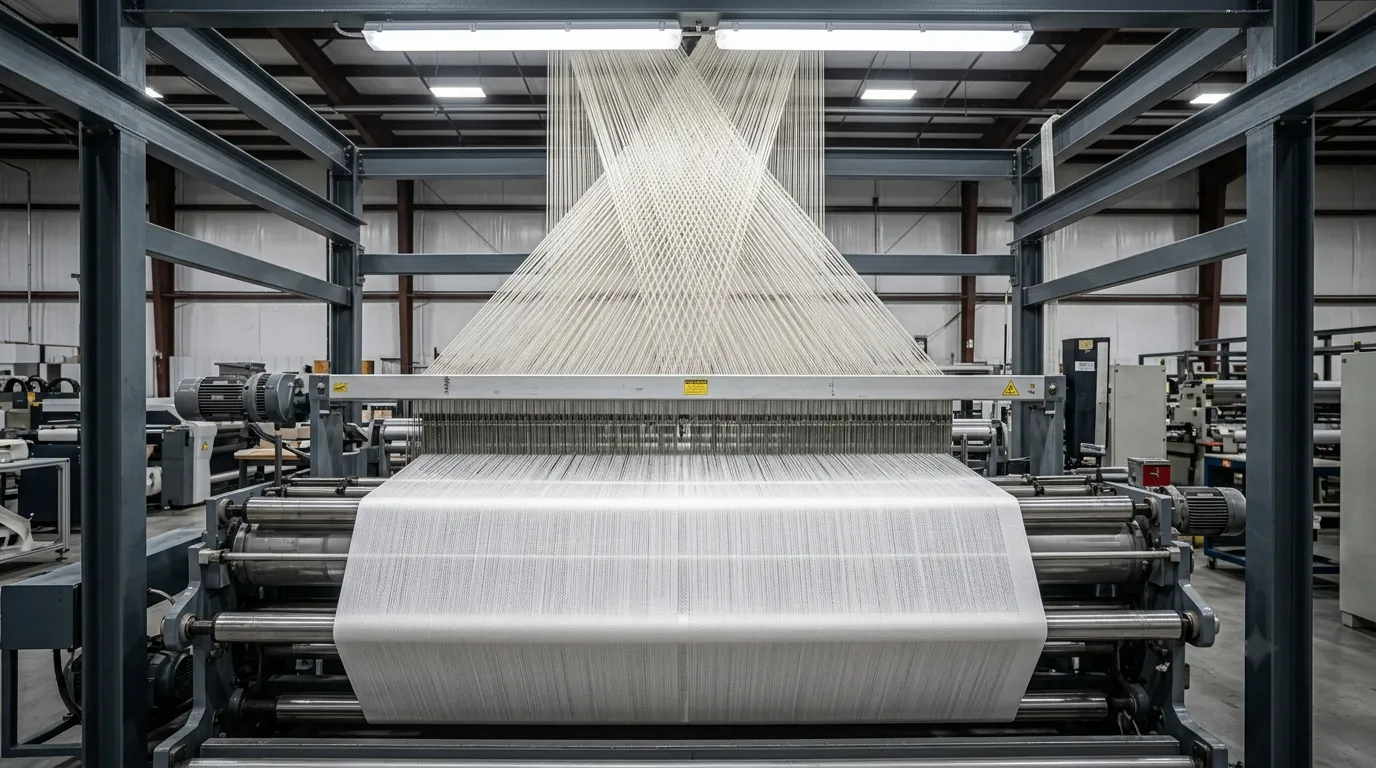
Step 4: Weaving the Fabric
Tapes are woven into fabric on looms. There are two main routes:
- Circular looms weave a seamless tube of fabric. This is used for circular bags and for cross-corner loop designs, which need tubular fabric.
- Flat looms weave flat fabric that is later cut and joined into panels. This is used for U-panel and 4-panel bags.
The weave density and fabric weight (GSM) are set according to the safe working load the bag must carry. Heavier loads need stronger, denser fabric. For bags with electrostatic protection, conductive threads or dissipative yarns are woven into the fabric at fixed spacing.
Step 5: Coating or Lamination (Optional)
Some products need protection from moisture, dust or fine powder leakage. In that case the fabric passes through an extrusion coating line and receives a thin layer of PP or PE. Coating also gives a smoother surface for printing. If the material needs to breathe, the fabric is left uncoated or a ventilated construction is used.
Step 6: Fabric Inspection and Cutting
Before cutting, the fabric is inspected for broken tapes, gaps, colour variation and coating defects. Approved fabric is cut to the sizes needed for the body panels, base and top. Hot-knife cutting is commonly used because it seals the edges and stops the cut fabric from fraying, which keeps seams strong.
Step 7: Printing
Cut panels can be printed using flexographic or screen printing. Printing usually includes:
- Brand name and logo
- Handling and safety instructions
- Safe working load (SWL) and safety factor
- Batch or traceability details
Standards such as ISO 21898 require durable marking on the bag, so this is more than decoration. For custom orders, this step is where your branding is added.
Step 8: Preparing Components
While the body fabric is being prepared, the other parts are made ready:
- Lifting loops are cut from PP webbing or made from the body fabric. They carry the full load, so they get the most attention.
- Spouts for filling and discharging, in various diameters and lengths.
- Top skirts or duffle tops for easy filling.
- Baffles, which are internal panels that help baffle bags keep a square shape.
- Document pouches for labels and handling details.
- Liners (PE or other films) for products that need an extra barrier.
Step 9: Stitching and Assembly
This is where the bag takes its shape. Skilled operators use heavy-duty industrial sewing machines and high-tenacity thread to join the panels, attach the base, fit the spouts and sew on the lifting loops.
Key points in stitching:
- Seams use strong chain-stitch patterns, often with added safety stitching.
- Lifting loops are reinforced with box or cross stitching, because this is where the load is concentrated.
- Stitch length, thread type and seam allowance are controlled so all bags in a batch are the same.
- If an inner liner is required, it is fitted into the finished bag at the end of this stage.
The assembly method changes with the design. A circular bag needs fewer seams than a 4-panel bag, and a baffle bag needs extra stitching for the internal panels. This is why a good FIBC bag manufacturer keeps trained stitching teams for each type.
Step 10: Final Inspection, Load Testing and Packing
Finished bags are inspected for dimensions, stitching quality, loop strength, spout fit, printing and cleanliness. Sample bags from each batch are then tested. The main tests are:
- Cyclic top lift test. The filled bag is lifted repeatedly at a multiple of its safe working load, to simulate rough handling.
- Load-to-failure test. The load is increased until the bag fails, proving the safety factor.
- Compression or stacking test. This checks the bag’s stability under stacked weight.
- UV resistance test, where the bag is meant for outdoor use.
Once approved, bags are folded, bundled into bales, labelled and packed for dispatch. Bags that fail inspection are removed from the batch.
Quality Control and Testing Standards
Quality is checked at every stage, not only at the end:
Stage | What is checked |
Raw material | Grade, moisture, contamination, UV and additive levels |
Tape | Width, thickness, tensile strength |
Fabric | Weight (GSM), weave density, tensile strength, coating consistency |
Stitching | Seam strength, stitch pattern, loop attachment |
Finished bag | Size, spout, printing, cleanliness |
Batch testing | Cyclic top lift, load to failure, stacking, UV where needed |
Static control (Type C and D) | Electrical resistance and grounding performance |
The internationally recognised standard for FIBCs for non-dangerous goods is ISO 21898. Single-trip bags are generally tested to a 5:1 safety factor, while reusable bags need 6:1 or higher. In India, buyers also refer to BIS standards for FIBC, and electrostatic classes are assessed under IEC 61340-4-4. Always ask your supplier for the test report that matches the bag you are buying, and check the current version of each standard.
How Manufacturing Changes with Bag Design
The basic process stays the same, but some steps change with the bag type:
Bag design | What changes in manufacturing |
Circular (tubular) | Woven on circular looms, fewer side seams |
U-panel | Flat fabric cut and sewn into a U-shaped body plus two side panels |
4-panel | Four separate panels joined at all four corners |
Baffle bag | Extra internal panels sewn in to keep the bag square |
Type C (conductive) | Conductive yarn woven into fabric, grounding tab added |
Type D (dissipative) | Special dissipative yarns in the fabric, no grounding needed |
Food-grade | Made in a clean, controlled area with approved materials and liners |
To decide which design suits your product, read how to choose the right FIBC bag.
Customization Options During Manufacturing
A bag can be tailored at several points in the process:
- Size and shape (dimensions, height, base)
- Safe working load and safety factor
- Fabric weight and coating
- Top and bottom styles (open top, duffle top, spout top, flat bottom, discharge spout)
- Loop type and position
- Liners and special additives
- Colour and printing
Tell your manufacturer what you are filling, how you will fill and discharge it, and how you will store and transport it. Those details allow the right choices at the right steps.
What to Look for in an FIBC Manufacturer’s Process
Use these questions when you compare suppliers:
- Do they use virgin polypropylene, and do they test incoming material?
- Is tape extrusion, weaving and stitching done in-house or outsourced?
- Can they share test reports (cyclic top lift, safety factor) for the bag you want?
- Is every bag marked with its SWL, safety factor and batch details?
- Do they have separate processes for food-grade or electrostatic-protective bags?
- Do they offer samples before bulk production?
A supplier who answers these clearly usually has a controlled process behind the bag.
Sustainability in FIBC Manufacturing
Polypropylene is recyclable, and many FIBCs can be reused when made and rated for multiple trips. Modern factories also reduce waste by recycling tape and fabric offcuts back into the process (for non-food grades), controlling extrusion closely, and cutting precisely to limit scrap. Using one bag many times, or recycling it at the end of its life, reduces packaging waste.
Why Choose Handmada for FIBC Bags
Handmada supplies FIBC bags for industrial packaging needs. [Add 3–4 specifics here: your certifications, in-house production stages, available sizes and SWL range, testing facilities, industries served, location and export experience.] Only include claims you can document, since buyers and Google both reward accuracy.
Frequently Asked Questions
- What material are FIBC bags made of?
FIBC bags are made from woven polypropylene (PP) fabric. The fabric is made from stretched PP tape, and may be coated or uncoated depending on how much moisture and dust protection the product needs. - How are FIBC bags made step by step?
Polypropylene granules are melted and extruded into film, cut into tape, stretched, woven into fabric, optionally coated, cut, printed, sewn together with loops and spouts, then inspected and load-tested before packing. - What is the difference between circular and U-panel manufacturing?
Circular bags use seamless tubular fabric from circular looms, so they have fewer seams. U-panel bags are made from flat fabric that is cut and sewn into shape. - How are FIBC bags tested?
Sampled bags go through cyclic top lift, load-to-failure and stacking tests, with UV testing for outdoor use. Electrostatic-protective bags are also checked for electrical performance. - What is the safety factor of an FIBC bag?
It is the ratio between the load at which the bag fails and its safe working load. Single-trip bags are typically rated 5:1 and multi-trip bags 6:1. - Can FIBC bags be customised during manufacturing?
Yes. Size, fabric weight, coating, loops, spouts, liners, colour and printing can all be specified before production begins. - Are FIBC bags reusable and recyclable?
Bags designed and certified for multiple trips can be reused. Polypropylene can be recycled, although food-contact and contaminated bags need extra care.
Conclusion
An FIBC bag is the result of many controlled steps: choosing good polypropylene, extruding and stretching tape, weaving strong fabric, stitching it with reinforced seams, and proving its strength through testing. When each stage is managed well, the bag protects your product and the people handling it.
Ready to choose a bag? Start with the types of FIBC bags, follow our guide on how to choose the right FIBC bag, and then request a quote for FIBC bags from our team.