If you import bulk materials like grain, cement, fertilizer, minerals or chemicals, you will hear one question again and again: how much weight can an FIBC bag hold?
The quick answer: most FIBC bags carry between 500 kg and 2,000 kg (1,100 to 4,400 lb). Heavy-duty custom bags can go up to 3,000 kg. But the number printed on the label is only part of the story. Your product’s density, the bag’s construction and how you handle it all affect what the bag can safely carry.
This guide explains it in plain terms, so you can order the right bag the first time.
What Is an FIBC Bag?
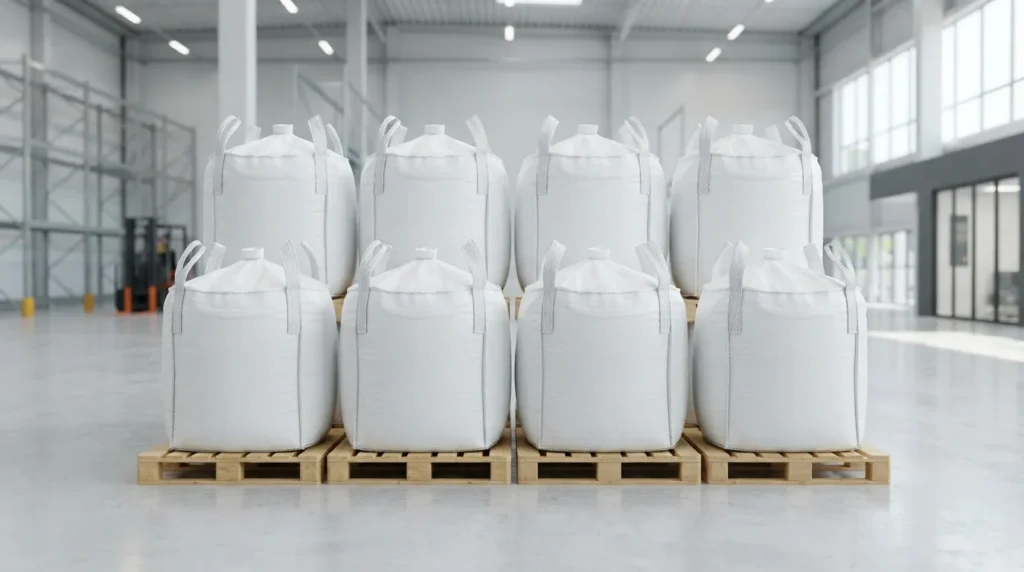
FIBC stands for Flexible Intermediate Bulk Container. You may also hear it called a jumbo bag, bulk bag, big bag or tonne bag. It is a large woven polypropylene bag with lifting loops, used to store and ship dry, flowable materials. If you want a full overview of the formats available, read our guide on types of FIBC bags.
The Short Answer: Typical FIBC Weight Capacities
Bag Capacity | Weight (kg) | Weight (lb) | Common Use |
Light duty | 500 kg | 1,100 lb | Seeds, small-batch chemicals |
Standard | 1,000 kg | 2,200 lb | Grains, sugar, fertilizer, minerals |
Heavy duty | 1,500 kg | 3,300 lb | Cement, sand, aggregates |
Extra heavy duty | 2,000 kg | 4,400 lb | Dense minerals, ores, metal powders |
Custom | Up to 3,000 kg | 6,600 lb | Specialised industrial loads |
Note: These are typical ranges. The exact capacity depends on the bag’s design and fabric.
Understanding SWL: The Number That Really Matters
Every genuine FIBC carries a label with its Safe Working Load (SWL). This is the maximum weight the bag is designed to carry safely during normal use.
Never fill a bag beyond its SWL, even if it looks like it still has room. The label is a safety limit, not a suggestion.
What Is the Safety Factor (SF)?
This is where many first-time buyers get confused. A 1,000 kg bag does not break at 1,000 kg. It is tested to hold far more than that.
The safety factor is the ratio between the load at which the bag fails and its SWL:
- 5:1 safety factor is used for single-trip bags (used once)
- 6:1 safety factor is used for multi-trip bags (reused several times)
For example, a 1,000 kg SWL bag with a 5:1 safety factor should withstand roughly 5,000 kg in a lift test before failing. This buffer protects against jolts, uneven lifting and real-world handling.
Safety factors and test methods follow international standards such as ISO 21898, which covers flexible intermediate bulk containers for non-dangerous goods. For dangerous goods, UN-certified bags must meet the rules set out by the UNECE dangerous goods framework.
6 Factors That Decide How Much Weight an FIBC Can Really Hold
1. Fabric strength (GSM)
The woven polypropylene fabric is measured in grams per square metre (GSM). Heavier fabric, typically 160 to 220 GSM or more, supports heavier loads. Cheaper, lighter fabric is the most common reason bags fail.
2. Stitching and seams
A bag is only as strong as its seams. Quality manufacturers use high-tenacity thread and reinforced stitching at stress points. To see where this happens, read how FIBC bags are manufactured.
3. Lifting loops
The loops carry the entire load during lifting. Their width, material and how they are attached to the bag body determine how well it handles the lift. Cross-corner loops and side-seam loops behave differently under stress.
4. Bag design
A baffled (Q-bag) design keeps its shape and stacks better, but a standard four-panel or U-panel bag may be better for other materials. Design affects both strength and how the load sits in a container.
5. Material density
This surprises many buyers. A bag has a weight limit and a volume limit, and you will hit one before the other.
Approximate bulk densities:
Material | Approx. Density |
Wheat / rice | 0.75–0.85 t/m³ |
Sugar | ~0.85 t/m³ |
Cement | ~1.4 t/m³ |
Sand | 1.5–1.6 t/m³ |
A standard bag holds about 1 m³. Fill it with light grain and you reach the volume limit at around 800 kg. Fill the same bag with sand and you would hit well over 1,000 kg, so you need a bag with a higher SWL.
6. Handling conditions
Bags in good condition and lifted properly will perform as tested. Bags exposed to UV light, rough forklift handling or long outdoor storage can lose strength over time.
Single-Trip vs Multi-Trip: Does It Change Capacity?
Not the SWL itself, but it changes the construction. A multi-trip bag (6:1) uses stronger fabric and stitching so it keeps its strength after repeated use. For export shipping where bags are used once, a 5:1 single-trip bag is the standard and most cost-effective choice.
Common Mistakes That Cause FIBC Failure
- Overfilling beyond SWL: the most frequent cause of breakage
- Lifting with one loop or at an angle: loads the bag unevenly
- Dragging bags across rough floors: damages the fabric and seams
- Ignoring dynamic loads: sudden drops or jerks multiply the force on the bag
- Reusing single-trip bags: they are not designed for it
- Storing in sunlight without UV treatment: degrades polypropylene
How to Choose the Right FIBC Capacity for Your Shipment
Follow these steps before placing an order:
- Know your material’s bulk density, then calculate the weight per cubic metre.
- Choose an SWL with a margin. If you plan to fill 950 kg, do not order a 1,000 kg bag that sits at its absolute limit.
- Decide single-trip or multi-trip based on your supply chain.
- Check the bag design (U-panel, 4-panel, baffled, with or without liner).
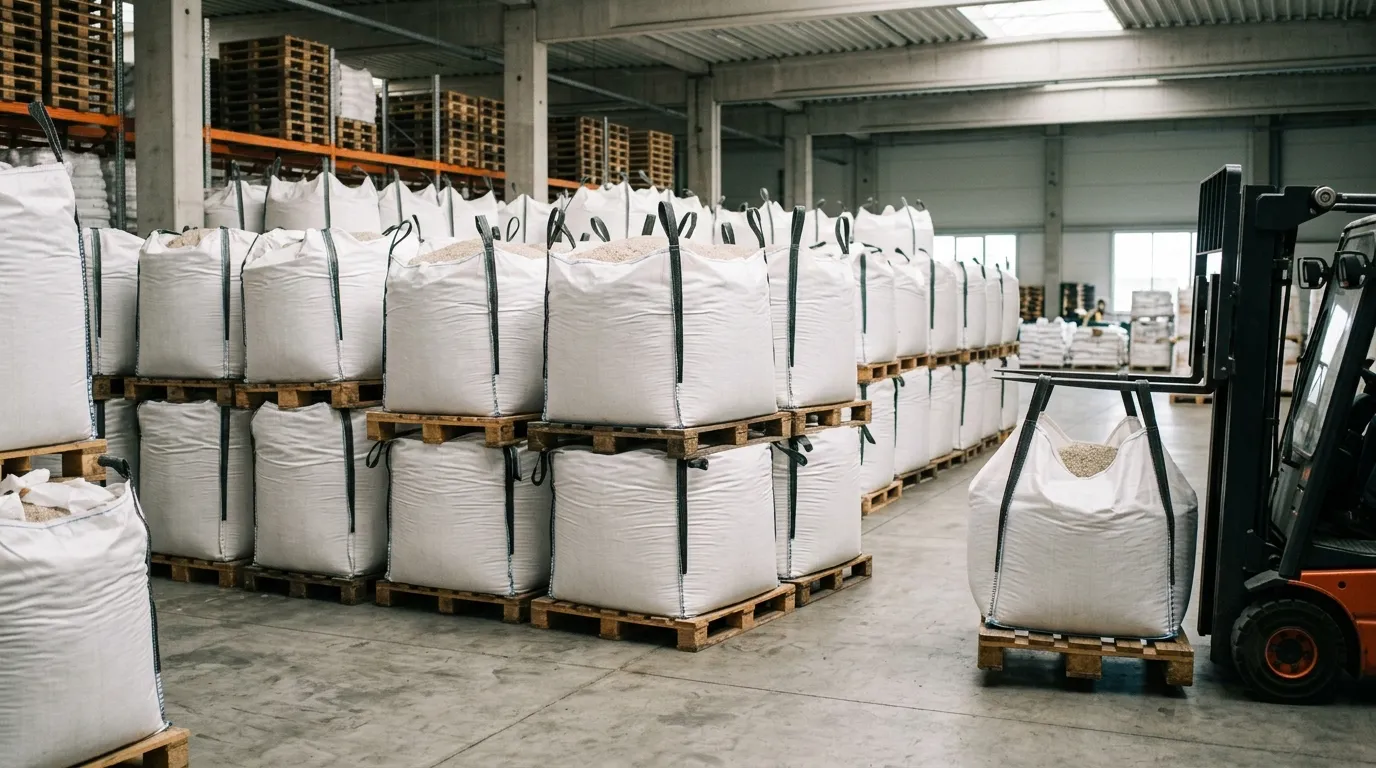
- Plan the container load. A 20 ft container typically fits a set number of bags, and a 40 ft container fits more. Your bag dimensions and weight directly affect your freight cost.
Our detailed walkthrough on how to choose the right FIBC bag for your bulk material covers each of these in more depth.
Why Source FIBC Bags From an Indian Exporter?
India is one of the world’s major FIBC manufacturing and exporting hubs, with strong polypropylene supply, large-scale production and experience shipping to Europe, the USA, the Middle East, Africa and Australia. For importers, that means competitive pricing, flexible customisation (size, SWL, loops, liners, printing) and reliable export documentation.
At Handmada, we have nearly four decades of experience supporting global buyers with consistent quality checks and clear communication from enquiry to shipment. If you are comparing suppliers, our guide to the best FIBC bag manufacturer from India explains what to look for.
Need FIBC Bags With a Specific Weight Capacity?
Tell us your material, target fill weight, destination market and quantity, and our team will recommend the right SWL and construction.
Explore our FIBC bag range
Send an enquiry for pricing, samples and lead time
Frequently Asked Questions
How much weight can a standard FIBC bag hold?
A standard FIBC holds 1,000 kg (2,200 lb). Other common sizes carry 500 kg, 1,500 kg and 2,000 kg, and custom bags can reach 3,000 kg.
What is the maximum weight an FIBC bag can hold?
Most commercial bags max out at 2,000 kg SWL. Specialised heavy-duty bags can be made for up to 3,000 kg, depending on fabric and design.
Does a 1-ton FIBC bag break at 1,000 kg?
No. A 1-ton (1,000 kg) SWL bag is built with a safety factor, usually 5:1 or 6:1, so it is tested to withstand several times its rated load.
What is the difference between SWL and safety factor?
SWL is the maximum load you should put in the bag. The safety factor is how many times that load the bag is tested to survive.
Can I reuse an FIBC bag?
Only if it is a multi-trip (6:1) bag in good condition. Single-trip (5:1) bags should not be reused.
How many FIBC bags fit in a 40 ft container?
It depends on bag size and whether they are palletised, so share your bag dimensions with us and we will calculate the load for you.
Final Thoughts
So, how much weight can an FIBC bag hold? Typically 500 to 2,000 kg, but the right answer for your shipment depends on SWL, safety factor, material density and handling. Get these right and you reduce breakage, claims and freight costs.
Choosing the correct bag is easier with a supplier who understands export needs. Contact Handmada and we will help you match the right FIBC to your product.